
What is core stability and how to reduce the risk of injury resulting from bad posture by improving it.
Core Stability can be described as ‘The ability to control the position and movement of the central portion of the body’.
Body Strength and power are derived from the trunk region of the body, and a properly conditioned core helps to control and utilise that power, allowing for smoother, more efficient and better coordinated movement in the limbs. Good postural strength will provide the foundation for ALL arm and leg movements.
The ability to maintain good posture helps to protect the spine and skeletal structure from extreme ranges of movement and from the excessive or abnormal forces acting on the body.
Ok, now for the technical bit…
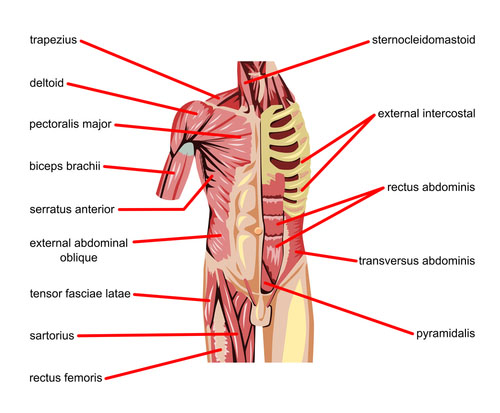
Core Stability relates to the bodily region bounded by the abdominal wall, the pelvis, the lower back and the diaphragm and its ability to stabilise the body during movement. The main muscles involved include the transversus abdominus, the internal and external obliques, the quadratus lumborum and the diaphragm.
In addition, it is the lumbar spine that is primarily responsible for posture and stability, providing the strength needed for stability and support. Without core stability, the lower back is not supported from inside and can be injured by strains and overloading of the area.
It is also believed that insufficient core stability and tight, inflexible muscles can result in continual lower back pain and poor posture.
It is not just the recruitment of these deep-trunk muscles that we are going to strengthen, but also how they are recruited and looking at the timing and coordination of these muscles
Whenever a person moves to lift something or simply to move from one position to another, the core region is engaged first. This engagement of muscles / tension is usually made unconsciously.
Feeling a muscle work or beginning to notice it work, is not only a very useful tool as a training aid, but also proves you do have them!
Before undergoing any form of exercise regime; If you have any previous medical conditions, are pre or post any operations, have an on-going injury, feel dizzy or faint through exercise, suffer from heart pain or are unsure of any other condition/problem at any time please stop and seek GP / medical advice.
An example to try;
Sit in a chair and apply light pressure with your fingers to the side of your abdominal wall. From here, simply lift one leg. You will feel a sudden engagement of the muscles.
Woohoo! Found them! Now to strengthen them!
Over the next series of blogs, I will show you easy-to-follow steps, not only on how to activate and work your core, but also on how to progress and feel the real benefit of having a strong, functional, flexible and powerful ‘Core’.
Homework…
For next session, you will need please;
Which size ball, after all size is important…
Ideally, while sitting on the ball, your hips and knees should be close to parallel with the floor (at a 90-degree angle). (If unsure ask someone to help).
Stability Ball Size Chart:
| User’s Height | Ball Diameter |
| under 4’10″ | 16″ or 42cm |
| 4’11″ – 5’4″ | 21″ or 55cm |
| 5’5″ – 5’11′ | 25″ or 65cm |
| 6′ and taller | 29″ or 75cm |
Please note, when you first blow up your new stability ball, inflate to around 85% for the first day, allow the ball to expand then on the following day inflate to around 95%
Job done, now for the work.