
Injury Prevention in Tennis
Every summer, it’s time to get out your tennis shoes and racquets. It’s vital to make sure that both you and your kit are properly prepared to prevent unnecessary injury. So here are some tips and advice to help guide you:
Tennis Top Tips
- Practice hitting the ball in the “sweet spot”, the shot feels good and the impact force will be at a minimum.
- Improve your stroking technique, especially backhand
- Modern racquets do not absorb shock like the old ones. To reduce the impact on your arm:-
– Lower string tension
– Increase flexibility of racquet
– Increase racquet head size
– Add lead tape to the head to increase weight
– Increase grip size. The optimum grip circumference equals the distance from the tip of the ring finger to the crease in the middle of the palm (proximal crease)
– Grip higher up handle
– Loosen grip on handle
- Play on an appropriate surface. If you play on a hard surface the forces through the joints are much higher: twice your body weight when walking, 3 to 4 times on running and 12 times on jumping. Very dry and hard surfaces can also cause twisting ligament injuries to the knees, due to the increased friction between your shoes and the ground.
- Get a biomechanical assessment and if you need them purchase bespoke high quality orthotics. Make sure your footwear is appropriate.
- Train at an intensity lower than competitive conditions to reduce the chance of injury
- Reduce the total amount of weight bearing exercise. Do some cross training to reduce impact loading, while maintaining training volume.
- Mix training sessions with different activities. I.e. cycling, swimming.
- Set up a training diary recording rest days, sleep, heart rate and heart rate recovery time.
- If the morning your heart rate increases, decrease activity plus add in more relaxation time, and spend more time on cool down post activity.
- Eat healthily and adjust your calorie intake to activity level. Take carbs for fuel, protein for rebuilding muscle, high quality vitamin & mineral supplements and drink plenty of water.
- Enjoy the stress relief exercise can bring and don’t force yourself if you are exhausted as this is when you are most likely to get injured.
- Get regular sports massage to remove trouble spots before they become injuries.
- If in doubt see a sports physiotherapist
Warming Up and Cooling Down
Warming up is often overlooked and should be part of your injury prevention routine as there are a number of benefits:
- The muscles work better when warm and oxygenated with good blood flow.
- The joints become more flexible which reduces the pull on muscles.
- The nervous system becomes more responsive.
Including a gentle jog in your warm up will give the muscles the energy supply they need to work properly. Follow this with sport specific exercises and dynamic, sport specific stretching drills. This regime has largely replaced old fashioned static alternatives.
Examples of tennis specific exercises are running for 5 to 20 minutes with heels up to buttocks, or with high knees up to hip level. Increasing the size and speed of movements, as the body warms up and the heart rate increases, will more closely simulate competitive conditions. It is also important to focus on full body conditioning, as predominantly one sided sports, such as tennis, can cause muscle imbalances.
You should allow a total exercise and stretch time of 15 to 30 minutes and no more than 30 minutes before competing, otherwise the benefits will be lost.
Cool down should include a gentle jog plus light stretching to help eliminate waste products and reduce muscle soreness.
If you need help contact the clinic on 01889 881488 and see a physiotherapist or visit www.painreliefclinic.co.uk
Fitness & Exercise Pillar
I believe fitness and wellness go hand-in-hand. When our bodies are fit it anchors a sound mind. The pleasure from moving effortlessly envelopes the mind in bliss. This leaves our mind free to concentrate on the pleasures of life.
So how can you achieve a fit body with a busy lifestyle? You need to understand how much movement your body craves and when to rest if fatigue hits.
5 Top Tips to Everyday Fitness
- If you drive a car for more than half an hour, park away from your destination and walk briskly, swinging your arms. This will ease the pressure on your spinal discs, loosen stiffened joints and improve blood flow.
- If you work at a desk, swap your chair for a fit ball. The small movements keep your mind focused and your spine healthy.
- At least ten times a day take three deep breathes. This improves blood flow and sends signals to the brain to reduce the stress chemistry.
- By adding in a pilates move of gently pulling in the stomach button to the spine or slow outbreathes, you boost your core postural muscles.
- Follow a weekly plan of activity, like mine listed below. If you wish to achieve a steady progression of fitness , or get fit for a holiday or sports activity, as the guidance of a fitness instructor, ask ….. at the clinic.
Example of My Summer 7 Day Programme – suitable for those working full-time
Sat/Sun Power walk or cycle outside for at least half an hour to two hours if not exercising at a gym.
Monday/Wed/Fri Resistive exercises in gym with weights for 45 mins. Fast swim for 30 mins.
Tues/Thur Fit ball, stretches and core work-out for 30 mins at home.

Spinal Vertebra and Nerves Exiting Spinal Chord
With our hectic modern lifestyle, there can be so many reasons why we don’t have a healthy spine. As I have explored in my previous articles, keeping healthy involves four key things; state of mind, diet, exercise and posture.
The spinal cord and nerve roots are housed in a bony structure, the spine, to minimise fraying and compression to sensitive neural structures, further protected by cushioning discs and strong muscles.
If you are unable to eat a healthy diet or have chronic stress, the gut cannot absorb nutrients effectively. The body then starts to crave these missing nutrients and literally rapes the spinal bones of minerals to sustain the vital organs. This accelerates wear and tear in the small finely chiselled spinal facet joints that allow us to twist and turn. They become prematurely arthritic and fire off pain receptors.
Daily impacts due to heavy footsteps on solid surfaces, cause faster wear and tear. Furthermore, with sustained poor posture in walking and sitting, amplified by not drinking enough water, the cushioning discs will crack and bulge. Then the fragile nerves are put at further risk by weak muscles. They turn into sensitive dysfunctional nerves which cause muscle contractures, accelerating arthritis, disc damage and general aging.
Hence the way we move will affect the harmonious flow of movement up through all the small joints in the spine. The correct structural alignment of feet, legs, pelvis and spine is very important, especially if you are very active and sporty. The science of how we move is called biomechanics, a physical expression of health, and a predictor of future problems.
So many times symptoms appear totally unrelated to the spine and yet unless recognized and treated the culprit lies dormant and the problem keeps reoccurring. Many times the symptoms of pain, numbness, weakness and pins and needles can be anywhere else in the body but the spine. So often, seemingly unrelated painful conditions such as osteoarthritis, tendinitis or unrelenting sports injury can only be resolved specialist neuropathic treatment to the spine. I firmly believe if anyone has a problem anywhere in the body the neural link to the spine must be assessed. Furthermore with shortened muscles compressing nerves such as sciatica in the leg, or brachialgia in the arm, the best way to quickly release the tight muscle contractures is with laser and a specialist pain treatment called GunnIMS. We are the only centre in Europe to offer teaching internships in IMS pain relief, after being awarded the highest accolade in treatment and lecturing internationally on this subject.
We very much embrace this approach in the clinic, with our specific diagnostic physical and functional tests.
Get in touch to find out more.
Pain Relief, Physiotherapy and Sports Injury Gem in Staffordshire
We all have a tendency to think that things are better elsewhere. How many of us never go to see local attractions, but happily drive miles to see the same elsewhere, when at the same time people who live miles away travel to see our local attractions.
Staffordshire may not be London, but that doesn’t mean there aren’t some real gems here that you can’t get elsewhere. One such gem is Nicky Snazell’s Pain Relief Clinic.
We provide a unique combination of skills and technology, unmatched in the UK. That’s why we have patients from every corner of the UK and we have many patients from abroad. Our furthest referral is from Sydney, Australia!
So next time you need help with chronic spinal pain, physiotherapy, arthritis or a sports injury don’t fall into the trap of thinking you need to go elsewhere. You have a gem on your doorstop.
We serve the local community including:
- Stafford
- Rugeley
- Cannock
- Lichfield
- Uttoxeter
- Stone
- Stoke on Trent
- Burton on Trent
- Walsall
- Wolverhampton
- Sutton Coldfield
Affordable shockwave is available. The best guidelines are to check out the training undertaken and how long shockwave has been used.
History
Radial shockwave has been in use in mainland Europe for over 30 years and because of its effectiveness, it is now spreading rapidly around the world. The UK has been relatively late in taking this exciting technology on board and even now there are relatively few clinics offering radial shockwave.
We have been offering affordable shockwave at Nicky Snazell’s Pain Relief Clinic since 2007, following an education trip to mainland Europe, including training from an Orthopaedic Consultant who specialises in shockwave treatment at his clinic in Luxembourg.
What is Radial Shockwave?
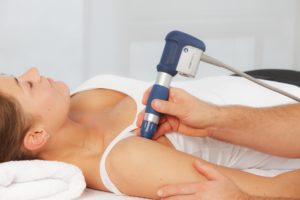
Shoulder Shockwave Treatment with Storz Medical ESWT
Radial shockwave applies pressure pulses to the body in varying depths. Our Storz Medical ESWT radial shockwave can be fitted with various applicator heads, which allows us to control depth of treatment and the quality of the pulse for different body tissues.
The head can be rapidly changed to treat a tendon insertion to the bone, the body of the tendon, or through the protected D-Actor technology, treat muscles. The pressure pulses induce an inflammatory response in the injured body tissue, which stimulates the body to react by increasing blood flow to the area and thus promotes more rapid healing.
Picture supplied by courtesy of Storz Medical
What Can Be Treated With Radial Shockwave?
Radial shockwave has a broad range of successful treatment capability:
- Plantar Fasciitis | Policeman’s Foot
- Patellar Tendonitis | Housemaids knee
- Tibial Stress Syndrome | Shin splints
- Achilles Tendonitis
- Lateral epicondylitis | Tennis Elbow
- Adhesive capsulitis | Frozen shoulder
- Calcified tendinitis
- Iliotibial band syndrome
- Osteoarthritic joint release
- Piriformis syndrome
- Muscle spasms & trigger points
How do I find a Skilled / Affordable Shockwave Therapist?
Often in life the maxim “You get what you pay for” holds true. However, with radial shockwave this is not necessarily the case, because radial shockwave is still relatively new in the UK, the apparent newness is being used to leverage extremely high charges. But radial shockwave is not new, it has been around for 30 years or more in one form or another. It’s just that the UK has been slow to take it on board.
At Nicky Snazell’s Pain Relief Clinic, our approach has been to seek the best training we could obtain in mainland Europe from Orthopaedic Specialists with many years of experience in shockwave and then make the treatment available here at normal treatment costs.
So look around, ask what training has been undertaken and how long shockwave has been in use at that centre. These are much better guidelines than cost.
If you are interested in affordable radial shockwave treatment at Nicky Snazell’s Pain Relief Clinic
CALL 01889 881488 NOW
Core Stability
What is core stability and how to reduce the risk of injury resulting from bad posture by improving it.