
Nicky Snazell offers her views on the Fitness & Exercise Pillar of the Optimum Health Parthenon in this article originally published in Staffordshire Life.
I believe fitness and wellness go hand-in-hand. When our bodies are fit anchors a sound mind. The pleasure from moving effortlessly envelopes the mind in bliss. This leaves our mind free to concentrate on the pleasures of life. Fitness helps us to avoid chronic pain and promotes well being.
So how can you achieve a fit body with a busy lifestyle?
You need to understand how much movement your body craves and when to rest if fatigue hits.
5 Top Tips for Everyday Fitness
- If you drive a car for over half an hour, park away from your destination and walk briskly, swinging your arms. This will ease the pressure on your spinal discs, loosen stiffened joints and improve blood flow.
- Swap your chair for a fit ball if you work at a desk. The small movements keep your mind focused and your spine healthy.
- At least ten times a day, take three deep breaths. This improves blood flow and sends signals to the brain to reduce stress chemistry.
- You boost your core postural muscles by adding a pilates move of gently pulling in the stomach button to the spine or slowing outbreathes.
- Follow a weekly plan of activity, like mine, listed below. If you wish to achieve a steady progression of fitness or get fit for a holiday or sports activity with the guidance of a fitness instructor, ask … at the clinic.
Example of My Summer 7-Day Programme – suitable for those working full-time
| Sat/Sun | Power walk or cycle outside for at least half an hour to two hours if not exercising at a gym. |
| Monday/Wed/Fri | Resistive exercises in gym with weights for 45 mins. Fast swim for 30 mins. |
| Tues/Thur | Fit ball, stretches and core work-out for 30 mins at home. |
For more tips

Spinal Vertebra and Nerves Exiting Spinal Chord
With our hectic modern lifestyle, there can be so many reasons why we don’t have a healthy spine. As I have explored in my previous articles, keeping healthy involves four key things; state of mind, diet, exercise and posture.
The spinal cord and nerve roots are housed in a bony structure, the spine, to minimise fraying and compression to sensitive neural structures, further protected by cushioning discs and strong muscles.
If you are unable to eat a healthy diet or have chronic stress, the gut cannot absorb nutrients effectively. The body then starts to crave these missing nutrients and literally rapes the spinal bones of minerals to sustain the vital organs. This accelerates wear and tear in the small finely chiselled spinal facet joints that allow us to twist and turn. They become prematurely arthritic and fire off pain receptors.
Daily impacts due to heavy footsteps on solid surfaces, cause faster wear and tear. Furthermore, with sustained poor posture in walking and sitting, amplified by not drinking enough water, the cushioning discs will crack and bulge. Then the fragile nerves are put at further risk by weak muscles. They turn into sensitive dysfunctional nerves which cause muscle contractures, accelerating arthritis, disc damage and general aging.
Hence the way we move will affect the harmonious flow of movement up through all the small joints in the spine. The correct structural alignment of feet, legs, pelvis and spine is very important, especially if you are very active and sporty. The science of how we move is called biomechanics, a physical expression of health, and a predictor of future problems.
So many times symptoms appear totally unrelated to the spine and yet unless recognized and treated the culprit lies dormant and the problem keeps reoccurring. Many times the symptoms of pain, numbness, weakness and pins and needles can be anywhere else in the body but the spine. So often, seemingly unrelated painful conditions such as osteoarthritis, tendinitis or unrelenting sports injury can only be resolved specialist neuropathic treatment to the spine. I firmly believe if anyone has a problem anywhere in the body the neural link to the spine must be assessed. Furthermore with shortened muscles compressing nerves such as sciatica in the leg, or brachialgia in the arm, the best way to quickly release the tight muscle contractures is with laser and a specialist pain treatment called GunnIMS. We are the only centre in Europe to offer teaching internships in IMS pain relief, after being awarded the highest accolade in treatment and lecturing internationally on this subject.
We very much embrace this approach in the clinic, with our specific diagnostic physical and functional tests.
Get in touch to find out more.
Unless you fall off, cycling is a sport that causes very little, if any impact injury and is relatively body-friendly. On the road, there’s no impact to jar your joints as you would find in running. In mountain bike riding, although there is still no direct impact there is an element of vibrational force depending upon the type of terrain you ride. Like any endurance sport however, cycling can produce a catalogue of niggling aches and pains, which unless diagnosed and properly treated can often lead to something more serious.
If you are a regular cyclist, maybe training for you first charity ride or even a sportive, it is important that you know how to spot the signs of an injury and that you get the correct treatment and advice to correct any problems.
Avoiding Injury
When you start to increase the amount of riding you do you will be adding stresses and strains on your body. You might be tempted to ignore slight niggles and stick to you training programme at all costs. BEWARE. Riding through the pain is very likely to turn what may be a minor problem into a major one.
If you get injured, take it seriously. Take some time off the bike or adapt your training regime but do not ignore it. If the problem does not ease after rest, it is wise to be assessed by a physio or sports injury therapist. Whatever you do, don’t ignore a potential injury when it’s still in the niggle stage.
Common Injuries
Other than the obvious flesh wounds and trauma caused by falling off there are the less impressive but no less painful sprains and strains caused by overtraining/overuse injuries often resulting from biomechanical stress caused by muscle imbalances or incorrect bike setup.
Knee
One of the most common injuries reported by cyclists is pain in/around the kneecap. This is often likely to be an overuse injury. Patellofemoral pain syndrome or Chondromalacia patellae are two possible causes and are usually found because of tightness or weakness in associated muscles that causes unwanted movement of the kneecap (patella) as you pedal. If the patella rubs on the bones behind it, this can irritate and inflame the cartilage at the back of the cap causing pain.
Similar symptoms can be caused by your illiotibial (IT) band becoming tight and pulling the kneecap out of line causing it to rub against underlying bones. If you consider the repetitive nature of the pedalling action – up to 5,000 pedal revolutions an hour – it’s no surprise that a problem like this can quickly escalate into a clinical injury.
The stabilising muscles of your hip/pelvis play a big part in preventing your knees rolling inwards, and can be weakened by an over tight IT band. This is one factor that may lead to a number of painful problems, including medial knee pain, anterior knee pain and even lower back pain, in cyclists and also runners.
Hip
A number of issues can give rise to hip pain one of the most common is Piriformis syndrome. This is often caused by overtraining (particularly if there is a muscle imbalance) and by overworking the gluteus maximus muscles in your buttocks. If overstressed and tight, the piriformis can put pressure on the sciatic nerve, causing pain or numbness down the back of the leg or in the hip and is a common cause of sciatica.
Neck
Pain caused by neck hyperextension can be exacerbated by positional issues on the bike combined with lack of flexibility and core strength. The deep muscle of the neck ( flexors/extensors) help to hold your head up, when they become weak it is left to the trapezius and other muscle groups to support your head as you lean forward. When these muscles get fatigued, you can get the aches and pains in the back and sides of your neck.
Lower Back
After knees, the back is probably one of the biggest causes of pain reported by cyclists. Again lack of flexibility and a poor posture/set up are often the cause. The neutral position for the spine in a standing position allows for the curves of the spine to take your bodyweight and for the muscles to be relaxed. Sitting and reaching forward causes tension in some of the muscles of the spine and can stress the joints causing aches and pains particularly in the lower back and across the shoulders. In extreme cases long periods of being in a bent forward position can damage the intervertebral discs causing them to herniate.
Any exercise causes a small amount of inflammation in muscles, due to microscopic amounts of damage. After a long ride it is normal to ache for a day or so as the muscle repairs. This is often referred to as Delayed Onset Muscle Soreness (DOMS)
Hands
Numbness, tingling, or pain in your arm, hand, wrist, or little finger is all common symptoms especially following a long ride. Approximately one-third of all bicycling overuse injuries involve the hands. The two most common are handlebar palsy and carpal tunnel syndrome. By making some adjustments to your bike and by wearing some protective equipment, you can help prevent these injuries from occurring.
Handlebar palsy
Ulnar neuropathy (sometimes known as handlebar palsy) is caused by compression of the ulnar nerve at the hand and wrist. The ulnar nerve controls sensation in your ring and little finger and some of the muscular function of your hand. Compression of the ulnar nerve is a common problem for cyclists and is the result of direct pressure on the ulnar nerve from the grip on the handlebars and sometimes overstretching of the nerve when using the drop-down handlebar position for an extended period.
The pressure placed on the ulnar nerve results in numbness and tingling in the ring and little fingers, hand weakness, or a combination of both. Symptoms can take from several days to months to resolve. Rest, stretching exercises, and anti-inflammatory usually help relieve the symptoms. Applying less pressure or weight by adjusting your position will help prevent the condition
Carpal tunnel syndrome
Although it is less common than Ulnar neuropathy, carpal tunnel syndrome (compression of the median nerve) is another overuse injury that cyclists often experience. This often occurs when a cyclist holds the handlebars on top and applies pressure directly on the median nerve. Symptoms include numbness and tingling in the thumb, index, middle, and ring fingers and weakness of the hand. Although pressure from this riding position contributes to the symptoms of carpal tunnel, there can be other causes for hand pain and numbness, therefore, an evaluation for other possible causes should be performed by your health-care professional.
If you think you may have any of these conditions, it would be worth getting in touch with the clinic to make an appointment to have it checked out. Call on 01889 881488 now.
Pain Relief, Physiotherapy and Sports Injury Gem in Staffordshire
We all have a tendency to think that things are better elsewhere. How many of us never go to see local attractions, but happily drive miles to see the same elsewhere, when at the same time people who live miles away travel to see our local attractions.
Staffordshire may not be London, but that doesn’t mean there aren’t some real gems here that you can’t get elsewhere. One such gem is Nicky Snazell’s Pain Relief Clinic.
We provide a unique combination of skills and technology, unmatched in the UK. That’s why we have patients from every corner of the UK and we have many patients from abroad. Our furthest referral is from Sydney, Australia!
So next time you need help with chronic spinal pain, physiotherapy, arthritis or a sports injury don’t fall into the trap of thinking you need to go elsewhere. You have a gem on your doorstop.
We serve the local community including:
- Stafford
- Rugeley
- Cannock
- Lichfield
- Uttoxeter
- Stone
- Stoke on Trent
- Burton on Trent
- Walsall
- Wolverhampton
- Sutton Coldfield
Affordable shockwave is available. The best guidelines are to check out the training undertaken and how long shockwave has been used.
History
Radial shockwave has been in use in mainland Europe for over 30 years and because of its effectiveness, it is now spreading rapidly around the world. The UK has been relatively late in taking this exciting technology on board and even now there are relatively few clinics offering radial shockwave.
We have been offering affordable shockwave at Nicky Snazell’s Pain Relief Clinic since 2007, following an education trip to mainland Europe, including training from an Orthopaedic Consultant who specialises in shockwave treatment at his clinic in Luxembourg.
What is Radial Shockwave?
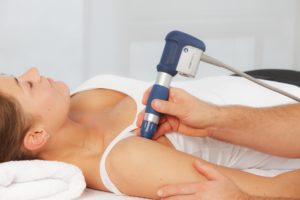
Shoulder Shockwave Treatment with Storz Medical ESWT
Radial shockwave applies pressure pulses to the body in varying depths. Our Storz Medical ESWT radial shockwave can be fitted with various applicator heads, which allows us to control depth of treatment and the quality of the pulse for different body tissues.
The head can be rapidly changed to treat a tendon insertion to the bone, the body of the tendon, or through the protected D-Actor technology, treat muscles. The pressure pulses induce an inflammatory response in the injured body tissue, which stimulates the body to react by increasing blood flow to the area and thus promotes more rapid healing.
Picture supplied by courtesy of Storz Medical
What Can Be Treated With Radial Shockwave?
Radial shockwave has a broad range of successful treatment capability:
- Plantar Fasciitis | Policeman’s Foot
- Patellar Tendonitis | Housemaids knee
- Tibial Stress Syndrome | Shin splints
- Achilles Tendonitis
- Lateral epicondylitis | Tennis Elbow
- Adhesive capsulitis | Frozen shoulder
- Calcified tendinitis
- Iliotibial band syndrome
- Osteoarthritic joint release
- Piriformis syndrome
- Muscle spasms & trigger points
How do I find a Skilled / Affordable Shockwave Therapist?
Often in life the maxim “You get what you pay for” holds true. However, with radial shockwave this is not necessarily the case, because radial shockwave is still relatively new in the UK, the apparent newness is being used to leverage extremely high charges. But radial shockwave is not new, it has been around for 30 years or more in one form or another. It’s just that the UK has been slow to take it on board.
At Nicky Snazell’s Pain Relief Clinic, our approach has been to seek the best training we could obtain in mainland Europe from Orthopaedic Specialists with many years of experience in shockwave and then make the treatment available here at normal treatment costs.
So look around, ask what training has been undertaken and how long shockwave has been in use at that centre. These are much better guidelines than cost.
If you are interested in affordable radial shockwave treatment at Nicky Snazell’s Pain Relief Clinic
CALL 01889 881488 NOW
Orthotics, when properly prescribed, can reduce pain and improve athletic performance.
Orthotics are footwear inserts custom designed and made specifically for you to correct imbalances in your body. Such imbalances may
- Cause you pain
- Affect your sporting performance
- Cause potential problems in the future
Orthotics can help correct fallen arches or high arched feet, leg length discrepancies and help resolve ankle pain, knee pain, hip pain, lower back pain, and they even make an impact all the way up the body to the shoulders, neck and jaw. Not surprisingly, for most of us, it is difficult to see that our back pain could be caused by a foot problem, and we will never make this link without assessment.
You may be wondering if you require orthotics or not, or may think that you can buy some insoles from a high street or online shop. It is important to realise such insoles are totally different to prescribed orthotics as they are not specifically designed for your feet and are generally made from a soft, short-lived material. While insoles can be helpful in certain circumstances, most of the time they are offering no relief to your problem and sometimes can make the problem worse.
We all have or own unique foot shape and movement problems. To make this complex structure perform correctly requires an orthotic to be made exactly to your needs. A custom-made orthotic will put your foot in an ideal position at every stage of walking, running and pivoting.
Would I benefit from orthotics, you may be asking yourself? If you fit into one of the groups below, then you will most likely benefit from orthotics:
- You know you have different leg lengths.
- You stand more than 6 hours a day, especially on hard surfaces.
- You are overweight.
- You suffer from arthritis.
- Sports players and runners exert much higher forces and are likelier to have problems.
If you feel you may require orthotics, then we can assess you here at the clinic. This is called a biomechanical assessment, and it involves a mixture of looking at your posture and a variety of special static and dynamic tests. This would include digital foot pressure measurement and looking at you walking on the treadmill. If, during the assessment, we spot any imbalances, then orthotics will most likely be needed.
If you wish to know more or feel that you may benefit from orthotics then feel free to contact us here at the clinic.
Core Stability
What is core stability and how to reduce the risk of injury resulting from bad posture by improving it.
Arthritis (also referred to as inflammatory joint pain) CAN be prevented with a few simple changes to your lifestyle. Information on what food you should eat and exercises you should do to help prevent getting the worst arthritis symptoms and if you do suffer from arthritis, what treatments are available.
We march into joint problems with innocent ignorance. A poor diet full of processed sugar, excess fat, caffeine and alcohol, leads to obesity, compounded by poor posture and footwear. On these dark winter days, we rarely get the correct amount of exercise to protect our joints, putting our bodies through repeated stresses and strains with weak muscles. On top of this, it is difficult to keep a positive mindset with such negative world news.
No wonder arthritis creeps in.
My patients often ask if they have arthritis and what type. They often think that fibromyalgia is a form of arthritis.
Broadly speaking there are two kinds; osteo (OA) and rheumatoid (RA). An examination by your physiotherapist or GP with xrays and bloods should determine which it is.
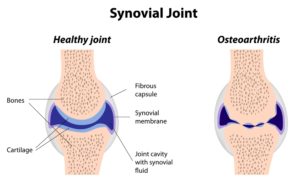
Osteoarthritic Joint
OA, the most common type, is wear and tear in the smooth cartilage protecting the bones in joints, which eventually leads to bone erosion, bone spurs and unsightly bony end thickening. The joint juice, the synovial fluid, swells and becomes inflamed and sticky. The attacked bone haemorrages precious calcium. By 50 years old 8 out of 10 of us have OA and by 60, 9 out of 10. Left untreated, OA can have a massive negative impact on quality of life and eventually need surgery. When bone is very fragile, it becomes osteoporotic and breaks easily. By the age of 70, 1 in 3 ladies suffer this.
Clearly, for everyone, it is well worth investing time to prevent the worst. I have mild OA in my right knee following surgery and if I follow the plan enclosed, I keep the symptoms at bay.
RA is totally different to OA, whereby the malfunctioning of the immune system is self-destructive to joints and muscles. It is linked to genetic makeup and is believed to be triggered by a viral attack.
I am frequently asked about Fibromyalgia, but this is not arthritic or inflammatory. The symptoms of fatigue, sleepless nights and muscle pain are believed to be a malfunction of the mitochondria energy processing system in the cell.
Action Plan
Exercise regularly every 48 hours, including gentle exercises like Tai Chi or Yoga when you are feeling sore and stressed up, and try to exercise outside to get your daily sunshine, vital for vitamin D.
Consult a nutritionist to check for food allergies and consider a liver function test. Many natural products support the liver, including milk thistle, artichoke and dandelion.
Increase fruit and vegetable intake, especially raw. Best for arthritis are; carrots, green peppers, watercress, tomatoes, beetroot, berries, grapes, cabbage, broccoli, Brussel sprouts and kale.
Eat less red meat, dairy, sugar-laden and deep fried food, drink less alcohol and caffeinated drinks.
Increase water, ionised if possible.
Consider supplementing, and check with a nutritionist. I take high-quality antioxidants, minerals and Omega 3 & 6 every day. Calcium, magnesium and phosphorus are very important for arthritis.
For fibromyalgia, 5 HTP can help sleep, try malic acid with magnesium for pain and to boost ATP energy cycle, manganese and coenzyme Q10.
Check your blood sugar level. Vitamins C,E, manganese and chromium can help with this.
Menopause can increase the problems with arthritis and fragile bones. Mineral uptake can be poorer, vitamin D low in winter, hormone levels of oestrogen and progesterone and parathyroid can be out of kilter. There are great self help books out there, and your GP can advise you on your hormones and bone density.
If pain worsens on walking, consider a biomechanical check for your footwear.
Suitable therapies I like:
- For RA (rheumatoid arthritis): laser, acupuncture, physiotherapy, massage and reiki.
- For Fibromyalgia: the above plus GunnIMS dry needling.
- For Osteoarthritis: in addition to all the above, shockwave and massage are excellent.
- For Osteoporosis: Shockwave