Here at Nicky Snazell’s Pain Relief Clinic, we see a vast amount of shoulder injuries, whether new acute injuries or chronic niggles that won’t seem to budge. Good shoulder function is integral to everyday living, and pain in this area can affect every aspect of our lives, from exercise and overhead reaching all the way down to getting dressed and sleeping. Acute sudden trauma and repetitive movements can both damage the musculature surrounding the joint and compromise the capsule itself, meaning simple movements can become painful, restricted and inaccessible. The majority of shoulder problems can be assessed and fixed successfully with the right treatment from an experienced physiotherapist.
Here in the clinic, we can identify and treat the underlying cause of your shoulder pain, enabling you to get back to a pain-free and functionally active life.
Understanding the shoulder joint
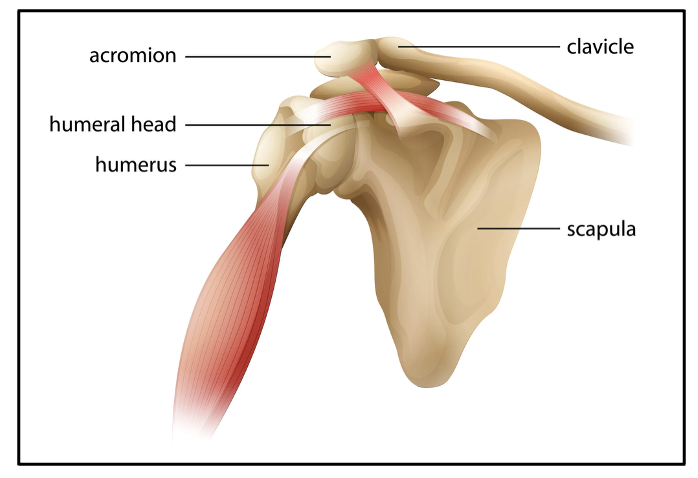
- Bones: The shoulder joint is formed by an articulation between the head of the upper arm bone (humerus) and a hemispherical recess in the shoulder blade (the glenoid fossa of the scapula), forming a ball-and-socket joint. This gives rise to the alternative name for the shoulder joint – the glenohumeral joint. The articulating surfaces are covered with hyaline cartilage and the fossa is deepened by a fibrocartilage rim called the glenoid labrum to give the humerus more stability.
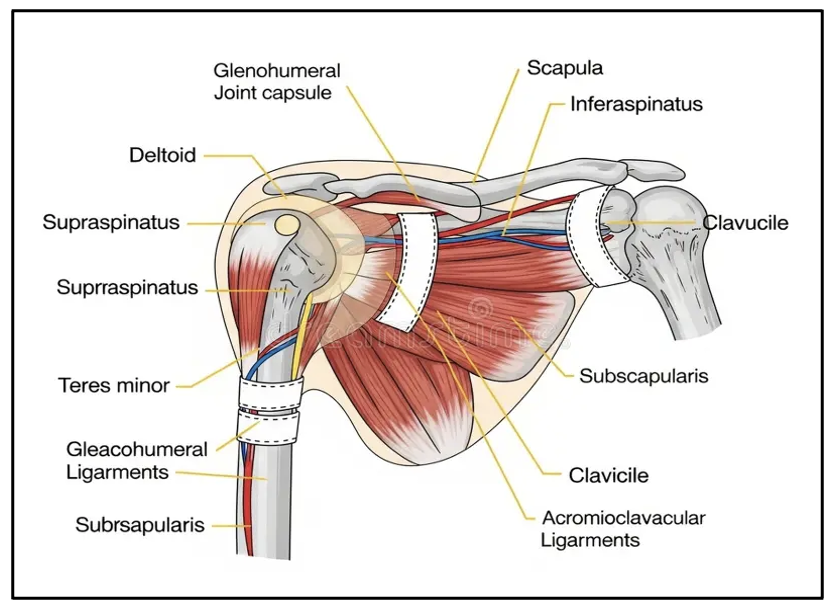
- Ligaments: these play an important role in stabilising the shoulder joint and connect to bones. The 4 main shoulder ligaments are the glenohumeral ligament, coracohumeral ligament, transverse humeral ligament and the coracoacromial ligament.
Tendons: these connect muscles to bones, keeping all of our interweaving musculature in place and providing some contribution to our strength and power in the arm.
- Bursae: a sac-like structure containing synovial fluid; it helps decrease friction between structures and provides cushioning. There are several in the shoulder joint, with the 2 main ones being: subacromial and subscapular.
- Muscles: There is extensive musculature that encapsulates the shoulder joint, allowing it to move and function; these start deep in the capsule itself and extend all the way down into our rib cage and lower back. The ‘rotator cuff’ is a group of 4 muscles we commonly see injured in clinic: supraspinatus, infraspinatus, subscapularis, and teres minor, which work together to stabilise and rotate the arm. Other large muscles, such as the deltoid, pectoralis major, and latissimus dorsi, articulate with the rotator cuff to enable the shoulder to flex, extend, and lift away from our body.
Common causes of shoulder pain
- Muscle tear or rupture – this can occur due to overuse, trauma or wear and tear. Most people think a rupture is acutely painful at the time, but we often see some older muscle injuries in the clinic that clients didn’t even know they had! A tear often leads to some sort of pain, weakness and difficulty in raising the arm.
- Shoulder impingement – a condition where a tendon in the shoulder swells and rubs against tissue or bone, causing pain and weakness; this often comes on gradually after repetitive activities. The tendon most frequently to suffer from impingement is attached to the supraspinatus, which is the muscle that starts the arm movement upwards away from the sides of the body.
- Frozen shoulder – also known as adhesive capsulitis, this occurs when the connective tissue around the shoulder joint thickens, tightens and becomes inflamed, restricting movement. It progresses through 3 stages (freezing, frozen and thawing) and can last multiple years in some cases. The exact cause is often unknown, but immobility after injury or surgery is a major trigger.
- Referred pain – pain you feel in one part of your body that originates elsewhere. Often we see recurring pain in the posterior shoulder (around the shoulder blade) or neurological changes such as loss of sensation or pins and needles that can seem like it’s a shoulder issue, but actually arise from the neck. This is why a physiotherapy assessment is so important, as we can make our way through the misleading symptoms and treat the route cause of your pain.
What can we do to help?
We have multiple modalities in the clinic that we can utilise to treat both acute and chronic shoulder injuries, such as:
- Subjective and objective assessment: the physiotherapist will ask you questions to understand your symptoms, medical history and movement limitations. We will then undertake a detailed objective assessment, looking at your movement, strength, and sensation, and palpating structures in/around the issue to locate the area of discomfort.
- Soft tissue and sports massage: using simple measures like our hands or a cupping set to release affected muscles and areas of myofascial tension.
- Acupuncture/Dry needling: using both traditional and Western methods to release tension, promote circulation, provide analgesia and accelerate healing.
- Deep oscillation: a gentle electronic device that uses electrostatic impulses to generate oscillations with the skin, connective tissue, muscles and lymph nodes. Often used for acute, swollen areas/new injuries to reduce inflammation and provide pain relief. All delivered through the therapist’s gloves.
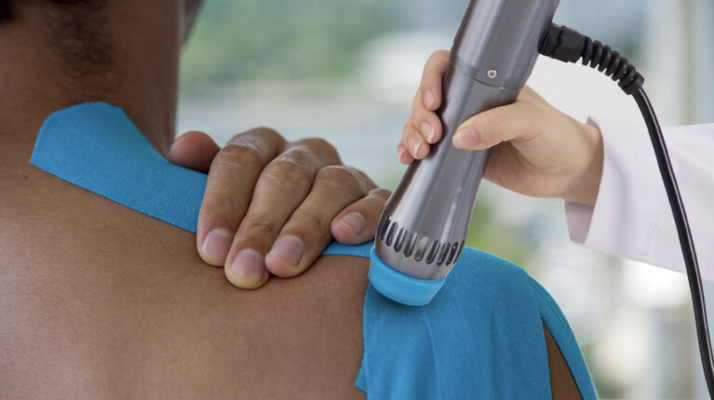
Radial and Focused Shockwave: devices that deliver high-energy acoustic waves through the skin into injured muscles and tendons through a handheld device. These waves are great at breaking down scar or thickened tissue, primarily used in chronic cases like tendinopathies. Radial shockwave is more commonly available and is used on problems that are not too deep, or where the area to treat is large. Focused shockwave is much more precise in targeting and can penetrate much more deeply than radial. Think of sniper versus shotgun.
Manual therapy and exercise prescription: Our therapists can use a variety of other hands-on modalities to increase range of motion at the shoulder and surrounding areas, as well as providing advice/training on specific exercises to work on from home.
Conclusion – Take the first step towards healthier shoulders
Recovery from a shoulder condition depends on the underlying condition and individual circumstances. But the quicker we can pinpoint the exact cause and treat it with the most effective modalities, the quicker you’ll be pain-free and back to normal activities. Consistency with rehabilitation and a personalised plan are integral to supporting the healing process and preventing further aggravation of symptoms.
If you’re struggling with any of the following:
- Persistent shoulder pain that isn’t improving
- Difficulty with everyday activities
- Pain affecting sleep
- Reduced strength or mobility
- Pain following sporting activity or repetitive movements
- Recurrent shoulder injuries
We can help – we will find the cause and get you on a program to resolve your problems. Contact us today on 01889 881488 to book a Physiotherapy assessment and discover how our physiotherapists can fix your shoulder pain and prevent further injuries.