
To help you refer, we have printed referral cards
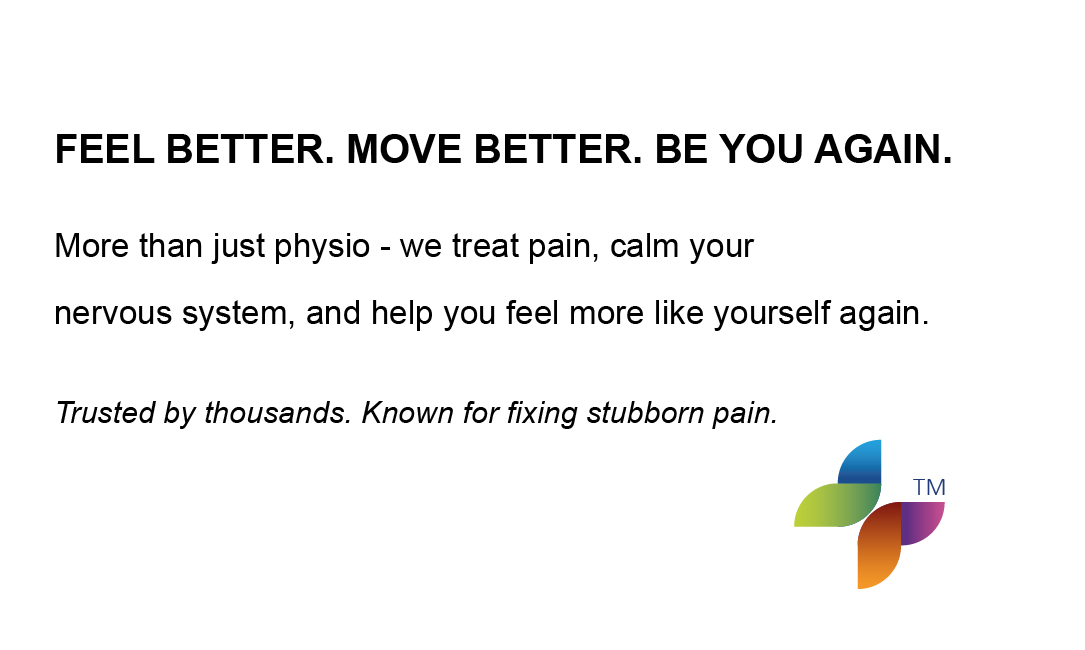
Most of our new clients come from people who care about others. But it’s not always easy to refer if you don’t know how to explain what it is we do. The fact is, we provide so much more than just physio, and by understanding this, you will find referring much easier. And each referral comes with a gift for you.
When a client presents us with a new problem, we consider it not just as a physical pain, but as three elements that can contribute to reducing the pain and restoring movement:
- Physical pain
- Nervous system
- How you feel on an emotional level
The location of the pain and its impact on the range of movement will be factors you can understand and communicate effectively. Less understood will be the interference with the nervous system, which can be the root cause of chronic pain. Its location can be physically far removed from where the pain is perceived to be.
An example of this is when nerves in the spine are compressed, yet the pain is perceived in the limbs, such as pain in the foot, even though the cause is in the lower (lumbar) spine.
There is, however, a further factor which is even more camouflaged and may not even be registered as existing to most, and that is locked-in trauma, potentially from a time much earlier in life. The trauma may not have even been physical. Instead, it may have been an emotional response to a traumatic event, and the mind locks in that emotion and links a physical pain to that emotion.
Thus, people can go through much of their life suffering pain, which fails to respond to normal treatments and in many cases is not even visible on modern scanning technology, including Xray and MRI.
In such circumstances the chronic pain being felt will not be resolved unless the root cause of that pain, the historic trauma, is first resolved.
Feelings thus become of significant importance, both elusive to resolve and difficult to communicate to others.
-
“They helped my pain, but something else changed too – I felt calmer, like I could breathe again”
-
“I can’t explain it – it’s not just physio, it’s like something reset”
-
“You just feel safe there. That’s when things start to change”
-
“They don’t just treat pain – they help you feel like yourself again”
How We Suggest You Refer
You may want to keep it simple and just say
“If it hurts and it moves – they treat it”
or use a broader description like
“I go to the Nicky Snazell Clinic. They don’t just treat the pain – they help you feel yourself again”

To help you refer, we have printed referral cards
You can get from reception. Just hand it to someone who mentions pain. That’s it, we will do the rest. As a personal thank you, we’ll credit your account by £20 for each person who turns up.
COMING SOON
Nicky Snazell’s powerful new novel weaves a fictional story with science and healing to explain how trauma locked in from the distant past can cause long-term, unresolved pain.

After decades of listening to people’s pain — shoulders that never quite relaxed, backs that carried too much, hearts that forgot how to rest — I finally wrote the story I have witnessed in so many of you.
Seven Lives, One Truth is not just a novel. It’s a journey back to the moment where emotional or physical trauma first took root — the moment the body buried it, and pain began to grow quietly through a lifetime.
Over the years, many of you have told me
“Nicky… I don’t know why this hurts. Nothing happened.”
But something had always happened.
Sometimes decades ago. Sometimes in childhood. Sometimes long before memory began.
This book travels through time to meet those forgotten moments — with compassion, with truth, with the healing presence I’ve spent my life practising. And it asks a simple but life-changing question:
What if healing the past could set your present free?
I’ve also written a song, Beyond Time, for the book launch — a deeply emotional piece that captures the heart of the story: the crash, the trauma, the souls seeking peace, and the light that guides us back home.
It was written for anyone who has ever carried pain too long. For anyone who has healed others but forgotten themselves. And perhaps… for you.
Thank you for letting me walk beside you on your healing journeys,
and for inspiring the pages of this book more than you know.
With warmth and enormous gratitude,
Nicky Snazell
We hope you liked “Beyond Time”, a song written and produced by Nicky, and that you are excited that you will soon be able to read “Seven Lives, One Truth”. The hope is that many of you will be able to identify similarities between your own personal situation and at least one of the avatars in the book, and in so doing be able to recognise your own trauma may be locked in from your past.
You may well have family or friends who have suffered long term pain and never understood why and thus never realised help was available. Please forward this email to all you think this may help.
Of course, you may just like “Beyond Time” enough to send the link to others so that they may enjoy the song as well.
If you would like to register your interest to buy the book “Seven Lives, One Truth” and be one of the first to receive it, then please complete the form below:
If you are in pain, we can help
Call Now 01889 881488

Struggling with pain that just won’t go away? Tired of feeling like you’re just another number in the healthcare system? At Nicky Snazell Clinic, we believe in a different approach—one that puts you and your needs first, offering not just relief but a path to a better, pain-free life.
For those of you who have been with us for a while, you already know the effort we put into making our clinic a special place. But it’s always worth taking a moment to reflect on what sets us apart and why that matters for you.
A Relaxing Escape Right on Your Doorstep
Our clinic, tucked away in the tranquil Staffordshire countryside, is more than just a place for treatment—it’s a space designed for your comfort and relaxation. The beautiful, restored grade II barn offers a welcoming retreat from the hustle and bustle of daily life. From the moment you walk through our doors, you’re greeted with a warm smile and a cosy atmosphere. Whether it’s the inviting sofas, the freshly brewed ground coffee, or the crackling fire on a cold winter’s day, we want you to feel at home.
We know that a calm mind is key to recovery, which is why we’ve put so much care into creating an environment that helps you relax. And of course, easy parking and direct access to the building mean that your visit starts smoothly, even before your treatment begins.
A Team That Cares Like Family
At the heart of our clinic’s success is our exceptional team. When we select new members—whether for therapist roles or administrative positions—we look for more than just technical expertise. We seek individuals who are team players, with a positive and caring attitude. This helps us maintain the warm, “part of the family” feeling that defines the Nicky Snazell Clinic.
Because we have advanced technology and skills not found elsewhere, the ability and desire to learn are paramount for every team member. To ensure our team stays at the cutting edge, we provide ongoing professional development through weekly CPD (Continuing Professional Development) sessions and bring in third-party experts for in-house training. This commitment to learning means that every member of our team is always ready to deliver the highest standard of care.
Advanced Technology, Traditional Care
One of our core beliefs is that effective pain relief requires both time-tested hands-on care and the right technological support. While we don’t have advanced imaging like MRI on-site, we’ve built strong partnerships with third-party providers to ensure you have access to high-quality imaging when needed. And the best part? We can secure competitive rates and rapid turnaround times, so you won’t be left waiting for answers. This ensures that you receive a swift and accurate diagnosis, enabling us to tailor your treatment effectively.
A Clinic Built on Passion, Experience, and Continuous Learning
Nicky Snazell’s lifelong dedication to helping people overcome pain is the heart of our clinic. Her journey has taken her from the UK to places like the USA, Canada, Korea, and China, where she sought out the best techniques in pain management, including GunnIMS. Her holistic approach, detailed in her first book The 4 Keys To Health, ensures that every client receives a tailored plan that addresses not just the symptoms but the underlying factors of their condition.
Alan, Nicky’s husband, joined the clinic with a vision of contributing in a meaningful way. Despite coming from a successful career as the Group Managing Director of six aerospace companies, he recognized the need to deepen his understanding of healthcare. Alan took this challenge head-on, studying anatomy and massage for a year, followed by a course in deep tissue massage, and then two and a half years of Chinese Medicine in London. He spent countless hours shadowing Nicky during over a thousand assessments and treatments, learning the nuances of client care and mastering the use of all our advanced technology.
For several years, Alan treated clients directly, applying his skills and knowledge to help them manage pain. His experience in hands-on care, combined with his technical expertise, provided a unique perspective that now informs every decision he makes in his current role. As the clinic grew, Alan transitioned to focus on administration, marketing and strategy, bringing a blend of hands-on knowledge and business acumen that has been instrumental in shaping the clinic’s direction.
A Focus on Lasting Results
We often see clients who first come to us for an acute problem, like a sports injury or back pain. But as many of you know, our approach doesn’t end there. For those managing chronic conditions, a little maintenance care can go a long way. Regular, but infrequent, treatments—often just four times a year—can make all the difference, helping to keep you active, pain-free, and enjoying life.
This preventative care not only keeps flare-ups at bay but also ensures that you don’t need more intensive treatment when problems arise. It’s about looking after your health, so you can keep doing the things you love without being held back by pain.
Thank You for Being Part of Our Family
At the Nicky Snazell Clinic, our clients aren’t just numbers—they’re part of our family, and we understand the importance of living a pain-free life. We’re here for you, just as you’ve been with us, and we’re always looking for ways to offer the very best care and support.
Thank you for trusting us with your care, and for being part of what makes our clinic such a special place. Here’s to many more years of health, healing, and happiness together.
Have you ever been haunted by a knife-like pain down your leg? Not just down your leg but in every aspect of your life. Making the simplest of tasks, like putting your socks on, impossible.
Imagine a pain that shadows you from the moment you get up and even haunts you at night, stopping you from sleeping.
You are not alone. Nearly half of us have suffered this at some time in our lives.
To learn more about sciatica and how to treat it, read on
It’s called sciatica and its root cause is a modern lifestyle of poor posture and weak muscles.
The videos explain what sciatic is and how the structure of the spine is vulnerable.
The sciatic nerve is a big nerve running from the back to the feet. Nerves, any nerves in your body in fact, don’t like to be squeezed and tell you quickly about this by causing pain. Typical causes of nerve compression are:
• Spinal discs act as cushions between the bony vertebrae, allowing movement and keeping the discs nicely spaced apart, allowing nerves to move freely and without pain. If those discs get compressed sufficiently, nerve compression and pain can result.
• Powerful back muscles can react to this nerve compression and go into spasm, increasing nerve compression and pain.
• Each pair of spinal vertebrae have joints between them to help control movement, called facet joints. These joints get worn with age and trauma and can eventually cause further nerve irritation.
• Our bodies are covered in a layer of connective tissue below the skin (imagine bubble wrap) and this tissue can become less flexible as we age, also leading to possible nerve irritation.
These underlying causes are nearly always quickly reversible with the correct lifestyle adjustments, adherence to exercise prescriptions and hands on physiotherapy. In more severe chronic cases, especially with locked in muscle spasm, specific dry needling may be required. There’s no one size fits all solution. A thorough assessment and treatment plan will be the most effective and fastest solution.
If your physiotherapist has any concerns, she or he can touch base with your doctor for bloods, x-rays or a scan.
Off the shelf pain meds, like anti-inflammatory with paracetamol can help. Your pharmacist can advise if its safe for you to take them with preexisting conditions or other meds.
or call 01889 881488
Jean, Erica & Charlotte will be happy to help
Do you remember studying hard at school to get good A levels? Your dream was to get accepted onto a physiotherapy university degree course, as the idea of helping people to get out of pain and live a higher quality of life really appealed to you. Physiotherapy suited your personality because it was a proven hands-on technique that made a measurable difference. And that was what you really wanted to do, to make a difference and help people.
All that hard work and determination got you the A levels you needed and you were accepted onto the course of your dreams. You started your career in physiotherapy determined to help people.
Now a few years on, as you look back on your career, you can’t help feeling that something is missing. Your dreams are not being fulfilled and more to the point, many of the skills you studied so hard to learn are not being used. You seem to be stuck on this treadmill of seeing patients, knowing you could help more, that you could make a bigger difference to their lives, but not able to as the guidelines are to avoid treatment wherever possible and send patients home with some exercises.
As you reflect on this, you wonder, if you continue this way, how you will look back on your life when you are retired. You realised there is a Grand Canyon-sized divide between your dreams at school and university, and what you were actually doing.
Now is the time to act, not tomorrow, as tomorrow never comes
At Nicky Snazell Clinic, we are 100% committed to providing the very best treatment we can, and it is exceedingly rare for that treatment not to involve hands-on, allowing our therapists to use the finely honed skills they were taught at university and refined in their years since. We of course incorporate exercises where appropriate and send online exercises with video links direct to the client. The clinic is also very well equipped with technology often only available in private practices and all this technology is available to all therapists to use free of charge.
Our therapists are able to devise meaningful treatment plans with their clients which will optimise the degree and rate of recovery from injury or pain and then go on to provide ongoing maintenance where needed to ensure that the improvements made are retained.
We have the luxury of both an excellent in-house MSK training resource, plus world specialist pain relief skills that attract clients from around the world, skills that are also readily taught in-house. Simply put, a combination of learning opportunities that’s hard to match.
Emma joined us as a MSK physiotherapist after 9 years of feeling restricted.
“I was so frustrated seeing patient after patient, never really helping them as much as I knew I could. It was equivalent to be trained to use a complete toolbox, but only allowed to use one tool.
The best decision I’ve ever made was to join Nicky Snazell Clinic. The breadth of their knowledge and skills still blows me away every day.
When I reflect back, I realise how my enthusiasm for being a physio was wilting. Now I’ve found my passion again and I can’t wait to learn something new and know there are no restrictions on me. I can now use every tool in the toolbox to get the best result possible.”
What Are You Going To Do Today?
There is no one right answer and we are all individuals. If the idea of actually treating MSK problems appeals to you, in an environment of total commitment to providing the best hands-on treatment possible, supported by an abundance of latest technology and ongoing learning from the best, then you should consider applying for an MSK physiotherapist role at Nicky Snazell Clinic.
You can be confident you will be applying for an opportunity at a well recognised facility. We have more Google reviews than most near us put together and we are rated 5.0, the highest possible. Our latest client satisfaction score was 93.5% and we have already taken action to address the improvement opportunities identified.
If this opportunity appeals to you, send in your CV and a covering letter to alanc@painreliefclinic.co.uk
Find out more about our clinic at www.painreliefclinic.co.uk
So, how do you choose your physiotherapy clinic in seven easy steps?
-
Physiotherapy skills and qualifications
The most important question - is the physiotherapist appropriately qualified and is there any evidence of ongoing learning and development? Although principals remain consistent, the skills and style of approach can be different as can the aftercare. Please make sure you get reassurances of qualifications and can see ongoing development of therapists.
-
Clinic Location
If you need physiotherapy, it is important to consider a local physiotherapist or one that is convenient to you. At Nicky Snazell Clinic we do provide specialist physiotherapy to clients from all over the world who come to Nicky for healing, but in general, we would recommend that you consider a therapist who is within a commutable distance of your work or home location. A commutable distance is 40-60mins for the right care, Nicky Snazell Pain Relief Clinic service; Stafford, Lichfield, Cannock, Rugeley & Stone.
-
Style of approach
Like people, physiotherapists are all different. While we hope that they all subscribe to the highest possible standards and approaches, it is important that you make sure that from the initial consultation you feel connected with your therapist and their unique style of approach.
Consider the following:
- Have your questions been answered?
- Did you feel a connection with the therapist?
- Are you clear on the next steps?
- Did the therapist explain costs?
-
Getting to the root cause
Spending time to find the root cause of pain is more important than the treatment itself. We find some clients have pain that is the result of unresolved childhood issues, bereavement and work-stress for example. Without spending the time to really understand your unique situation, often it can be like treating the surface of the problem and not the long-term view of the issue.
-
Ongoing Physiotherapy care
Once your initial condition and pain are 'fixed', ongoing care is essential. As they say, prevention is better than cure, so periodic check-ups and follow-ups will help ensure that you are maintaining your health. We quite often treat sports injuries and also recommend massage for clients which can relax and rejuvenate you avoiding the aggravation of the problem area.
-
Other services
Sometimes you may receive physiotherapy which can show that you would benefit from other services such as electro-acupuncture, the aforementioned massage. Does your therapist offer other services to support your wellbeing?
-
Customer service
A good physiotherapy clinic has a team who can facilitate customer support and great customer service, like helping you to book your appointments, reminders and periodic communication in the form of useful insights, tips and observations to help.
If you are looking for a Physiotherapist why not give our team a call: 01889 881 488
The Physical Assessment
In my three previous blogs on physiotherapy assessment
A Different Perspective On Your Physiotherapy Assessment
The Subjective Physiotherapy Assessment
The Subjective Physiotherapy Assessment - Part 2
I discussed concepts and steps which for most will not have been considered and most will have assumed that the physical assessment was the first step.
That is the mistake that so many make, missing out on the vital steps of creating the right environment to build connection and trust and gaining a deeper understanding of your important beliefs. Make that mistake and you are destined to gain so much less.
So the physical part of the assessment. What do we do? Well, in a private room we may ask you to take off some of your clothes, so you might want to be wearing clothes you're comfortable in and can take off quickly. If you're too shy to take off your clothes, just say it, it's not a problem.
Many of the assessments we make at my clinic are not common in the UK or anywhere else in the world. I am fortunate to have studied and qualified at the highest level in specific pain relief techniques and as a result I have learnt and ingrained advanced assessment techniques in myself and the rest of my team.
Then we'll be looking structurally at your skin. What does it look like? How healthy it is? What are the hairs like? Are there hairs missing? Does that mean the nerves are not working properly in that area? What's the temperature of the skin? Is it sweaty? Is it dry? How does the limb move? Does it move normally? If not, it will tell us is it’s likely to be arthritis in the joint that's blocking it. Or is it likely to be a tendon? Or a muscle or ligament? Or is it the nerves? Are they transmitting messages normally?
Or is it the brain? Has your brain created the pain felt in the body, possibly locked in from an emotional trauma many years earlier, even back to when you were a child? Chronic pain is created in many parts of the brain (evident in scans). Mindmapping physiotherapy techniques help to unwire the pain felt in the body.
So we're assessing the physical aspect. And that tells us so much about where we believe the problem is, or which systems are mostly causing the problem. Is it mostly the muscles? Is it mostly the nerves innovating the muscles? Is a blood flow problem? Is it something to do with what you are eating or if you don't move enough you are too weak. Or are you so stressed up, that you’re just pumping out inflammation into the area and you’re getting a more aggressive form of arthritis. And you don't need to. By looking at and at the same time feeling the response of your body, we learn a lot. If we hold a patient's hand that's sore, your eyes tend to move very differently than if you hold part of the body that isn't. Also there's a feeling about the hand, there's a hesitancy and there's a sort of a difference in the tone or strength.
There is so much in our senses, that we pick up on when we're assessing physically. Clearly this can only be done physically, face to face. Most of the above would be totally impossible to achieve by virtual means.
In my next blog Your Physiotherapy Prescription I’ll take you through how we develop a Physiotherapy treatment prescription, or plan, which takes you through the steps needed to achieve a successful outcome and let you get on with your life.
In the meantime, if you are in pain right now and you feel confident we can help, then why not call now. Erica, Jean and Charlotte will be happy to help.
Call 01889 881488 Now
p.s. Don’t try to book online at this time as that is only suitable for existing clients already being treated for an existing problem.
Ok, you are in pain, you have tried the obvious remedies, like pain killers and anti-inflammatories or a bit of exercise, but they didn’t fix the problem. You don’t want to be on drugs for too long, so you are thinking about getting to see a physiotherapist to assess you properly and find out what the problem really is and how best to fix it.
This presents you with a number of problems, such as where is the best physiotherapy clinic to go to and is it experienced with helping your type of problem. If you have friends or family who can provide help, based on their own experiences, then great. If not, the next best thing is to look at Google reviews and /or ask on social media. If you want some help on how to choose a clinic and what you need to ask, then click on this link How to Choose A Physiotherapy Clinic
You may have assumed that a physical assessment will be the first step.
That is the mistake that so many make, missing out the vital steps of creating the right environment to build connection and trust, and gaining a deeper understanding of your important beliefs. Make that mistake and you are destined to gain so much less.
Many of the assessment skills we use at my clinic are not common in the UK or anywhere else in the world. I am fortunate to have studied and qualified at the highest level in specific pain relief techniques and as a result, I have learnt and ingrained advanced assessment techniques in myself and the rest of my team.
Thus today, I want to approach this from a different angle, one you might not have thought of as being important, but trust me, it’s vital to a successful outcome. It’s the environment of the assessment room, and that means not only your room but the physiotherapists as well when the assessment is being done virtually.
You see, we all have an inherent ability to recognise if there is a true focus on the problem and that you are being listened to. If the environment is full of distractions or interruptions, then your physiotherapist’s thoughts will be disrupted and you will sense it. Your physiotherapist needs to be in the present moment, focussed and not allowing other thoughts to clutter up their head.
That’s my number one piece of advice.
Clearly, the environment is much better when you are face to face with the physiotherapist who is assessing you. There’s much less probability of distraction and that vital bond of trust is so much easier to build.
If your physiotherapist practices mindfulness techniques, they will induce a mental state capable of focussed attention on you. Your healing will commence as soon as you sense the caring intention.
I’m going to continue this explanation of how to achieve a successful assessment in more blogs. If you want me to keep with me on this journey, look out for my next instalment ‘The Subjective Physiotherapy Assessment’, which continues to look at this topic from a new perspective.
In the meantime, if you are in pain right now and you feel confident we can help, then why not call now. Erica, Jean and Charlotte will be happy to help.
Call 01889 881488 Now
p.s. Don’t try to book online at this time as that is only suitable for existing clients already being treated for an existing problem.
In my two previous blogs A Different Perspective On Your Physiotherapy Assessment and The Subjective Physiotherapy Assessment, I discussed the importance of getting that connection and really listening to get the patients story. Why are you here, what are your beliefs about treatment?
Now it’s time to go further, honing it down with specific questions about the problem.
Let’s use an example to help illustrate. Someone comes to me and they've had chronic pain in their foot for a very long time. I would be asking questions about the possibility of arthritis. Questions regarding the nervous system. Looking at the way that the body moves. Seeing if the pain is transmitting down from the spinal cord, because it could be a problem in the spine itself and not the foot at all. Having a look at the function of the foot, seeing if biomechanically the patient is walking in a strange way, and is that is making it worse?
How does it feel? How does the tissue feel? Is there any swelling? Are there problems with circulation? Is the sensation there? Are the nerves working properly? Is there an amplification of pain so that when I touch, the tissue is overly sensitive? What are the clues as to what's going on?
This is a very important start to this part of the assessment, which leads to the physical assessment.
To recap, the first part is establishing the connection and the story, the background, the beliefs, the values. The next part is to do with the Four Keys, to do with your immune system and your general health.
The next part is to hone it down into the particular problem today and how it's starting to manifest itself physically.
The final step is to go into the physical, which we can't do remotely by zoom. The physiotherapist has to get hands-on and assess physically, face to face.
In my next blog The Physical Assessment I will delve into the actual hands-on physical assessment. Many of you may have thought that this would be the first step in an assessment and that is the mistake that so many make, missing out on the vital steps of building connection and trust and gaining a deeper understanding of the all-important beliefs of the client. Make that mistake and you are destined to gain so much less.
In the meantime, if you are in pain right now and you feel confident we can help, then why not call now. Erica, Jean and Charlotte will be happy to help
Call 01889 881488 Now
p.s. Don’t try to book online at this time as that is only suitable for existing clients already being treated for an existing problem.
I get asked a lot of questions about physiotherapy assessment. What do we do at my clinic? How do I assess? How do I teach assessing?
In my previous blog A Different Perspective On Your Physiotherapy Assessment, I mentioned that the first and most important thing is to have a safe, quiet environment that builds a connection and trust. If you don't feel that with your physiotherapist, you're not going to want to proceed to any kind of medicine or treatment and your outcome won't be as successful. There won't be that connection.
To recap, the most important thing for the patient is that the physiotherapist has created a sacred space, a quiet office, where the phones are switched off, the computer is not a distraction, and you eyeball each other to get that connection. And then your physiotherapist listens to your story. And how you describe what's going on with you. And then, in that moment of connection, your physiotherapist can get glimpses of the real authentic self behind the story, who you really are.
Once your physiotherapist glimpses the story of the problem, he or she can start to elicit some background which is past medical history. So we'll ask questions like the health of your family to see if there are relevant genetic links. We may also explore your beliefs and values and more about your family so we'll know how difficult it is for you to attend and for you to have the necessary treatment. We may touch on your past experiences of treatment because if you've been scared or let down previously, you're going to have very different expectations. We need to address that head-on.
And then, of course, my favourite four keys questions (see my first book ‘The Four Keys To Health’ available on Amazon), which looks into your mindset, lifestyle, fitness and what you eat. All these help us assess how well your immune system is working, and your general health, which helps refine our treatment prescription.
That, in a nutshell, is the first part of the physiotherapy assessment.
In my next blog ‘The Subjective Physiotherapy Assessment – Part 2’ I will continue on this journey of helping you understand how to really get the most out of this process.
In the meantime, if you are in pain right now and you feel confident we can help, then why not call now. Erica, Jean and Charlotte will be happy to help.
Call 01889 881488 Now
p.s. Don’t try to book online at this time as that is only suitable for existing clients already being treated for an existing problem.