Availability Of Treatment Has Never Been More Important
With the daily media bombardment about COVID, it is no wonder that fear is generally growing. Fear of the social impact of another lockdown, fear of the uncertainty of our livelihoods and even fear of our very existence. Staffordshire has announced that it will go to Tier 2 at midnight on Friday and this will inevitably raise the fear factor higher.
Mental health has taken a back step with this pandemic and never before in my working life has there been so much anxiety, loneliness and grief hidden away in society.
Your pain, whether physical, mental or both, isn’t going to disappear and many of you are going to need a lot of help in the coming months. Increasingly, we are being asked to help guide people through these difficult times both mentally and spiritually, the latter problems only serving to multiply the actual physical pain.
We Are Staying Open
We know that stress lowers our immunity and raises our sensitivity to pain. Gold standard trials have also proven a relationship between lifestyle stressors and white cell count. What this means is that stress, if left untreated, will slow down your ability to heal, plus worsen your response to pain, inflammation and disease. Yet psychosocial pain is, I believe, wrongly still an afterthought in western medicine, even though more often than not, it holds the key to hidden trauma and deep emotional stress.
At this clinic, we have long recognised the importance of looking at the whole person, rather than just the location of pain. That’s why, even though I am highly qualified in western medical techniques, I have written 5 books on a more holistic approach. In my first book, The 4 Keys To Health, I introduced a simple traffic light scoring system which encompassed the psychosocial factors that affect our health and which can cause so much of our pain.
Our goal is thus to help people in all aspects of their health and never before in my lifetime has there been such an urgent need for this approach. Beyond treating your pain, we wish to get you to as close optimum health as possible to help protect your immune system.
That’s why at the clinic we love to build a relationship with our clients to prescribe a tailor-made treatment plan, working out the best way to help with the mind set and adding in massage, and technology such as laser, shockwave, deep oscillation, acupuncture and IMS dry needling.
Keeping Abreast Of Research
We are constantly monitoring recent research to find new techniques to help. As an example, a recent Harvard trial successfully used electroacupuncture to improve survivability in COVID infected mice. This is highly relevant research, as in some cases it has been shown that it is the human bodies over response to COVID infection which has caused excessive inflammation [cytokine storm], leading in some cases to death. The research findings are significant. Electroacupuncture treatment before the cytokine storm increased survivability by a factor of four, from 20% to 80%. When applied after the cytokine storm, survivability increased by three-fold, from 20% to 60%. Both are huge benefits and it emphasises the benefit of preventative treatment.
As a result of our integrative approach to treatment, combining orthodox western medicine with alternative, we routinely carry out electroacupuncture here.
For those of you who need our help, we are open and will continue to be open unless forced to close by government ruling.
None of us know how long this pandemic is going to last, but the expectation is that it’s going to be a long time. If the availability of treatment is shut off there is going to be a drastic rise in pain and suffering. We have already seen this in the lockdown with patients begging us to see them. That’s why I believe it is so important that we stay open in the coming months.
Our patients are so grateful that we are here now to help them with their pain, pain they suffered for months without any help during lockdown. They have bombarded us with thanks. We will continue to stay open and help you unless and until the government dictates otherwise. Sadly, the chances are there will be few, if any, alternatives for you.
Control Your Stress Now And Improve Your Resistance To Disease
While the government is correct to react to rises in cases, we each need to keep in perspective what the tier trigger points represent, so that we can keep better control of our stress. Tier 2 is triggered at 100 per 100,000 population. Put another way, on average you would need to get close to 1000 people before you are likely to be near a COVID positive risk. How likely, if you are careful, are you to interface closely with 1000 people, especially in these troubled times? Maintain social distancing and always wear a mask to reduce your chances of infection further.
What does this tell us? Mix only with people you are reasonably sure act sensibly and act sensibly yourself. Nothing is guaranteed in life, but by acting sensibly and taking all possible precautions, you can use your own positive response to improve your health.
What We are Doing About COVID-19 At Nicky Snazell Clinic
COVID-19 has had a dramatic affect on all our lives and not surprisingly at Nicky Snazell Clinic as well. Our foremost concern is the safety of patients and staff and we strive to stay fully up to date with the almost daily changes and wherever possible keep ahead of the curve. More on that later.
Screening
Even if you are an existing patient, but definitely if you are a new patient, we will take you through a screening process to make sure it is safe and justified for you to come in for treatment. There will be quite a few questions, and we ask you to bear with us on this as it’s all in our best interests. For sure, the questions asked will constantly change in line with latest guidelines. Where the risk is deemed higher, then a more detailed assessment will be needed with a physiotherapist, before treatment can be authorised.
Please note that in cases where you may need to be accompanied, then that person also has to pass screening to be allowed on site.
Changes At The Clinic
All of our 13,000 plus patients will know that our aim has always been to create a welcoming, peaceful and relaxing environment from the moment you walk in the door. Well that of course, to an extent, went out the door when we adjusted rapidly to the pandemic. Our waiting room has been effectively closed and patients are now asked to wait in their cars until their allotted start time. At that point they should come in alone with a face mask on, use the readily available hand sanitiser and their therapist, wearing full PPE, will take them to the treatment room.
At the end of the appointment the therapist will, if necessary, book a follow-on appointment and we then ask that you go to reception, where we have installed protective screens, to pay in advance for the next appointment. To speed this process, we now only take payment by card and by touch whenever possible. Where a payment requires a pin, the terminal is sanitised after use.
We then ask that you leave the clinic immediately as we want to minimise time that patients are in the clinic. Please don’t think we are being rude if we don’t chat as we used to. We are minimising your time on site. We have also staggered the start times between therapists, to avoid multiple patients being on site outside of a treatment room at the same time.
Cleaning
All rooms are sanitised between treatments and thus treatment times will be slightly shorter. In addition, we use a spray which lasts up to 5 hours on surfaces and this is used on all common touch points every 3 hours. Thus, for example, when you open the door to come in, you can be sure that the handle and surrounding woodwork will have been sprayed and is as safe as is practical.
We understand of course that some patients will need to use the toilet and we request that if needed, you first advise us so that we can sanitise after each use. Note, however, that the toilet is also thoroughly sanitised every 3 hours with our 5 hour effective spray. Please try to avoid the need to use our facilities wherever possible.
Your Part
We require that you use a face mask which covers your mouth and nose at all times while inside the clinic. All of the available scientific information supports the need to wear masks inside a building. It is important for each of us to realise that wearing a mask helps protect those around us from us. By not wearing a mask properly, this would be putting our staff at additional risk and this is not acceptable.
Patients at times have found difficulty in wearing a mask, but we politely request that you must do so for the short time on site. Bear in mind that our staff are in full PPE all day to protect you.
Patients who do not comply with this request may be refused further treatment.
We also need your help in running to time. It is vital that you have vacated the treatment room on time, leaving sufficient time for the room to be sanitised. Any overrun will mean that patients will be held in the waiting room and this is not acceptable.
Payment In Advance
We have changed our payment procedure, as we now ask for payment in full at time of booking and in 99.9% of cases this has been fully understood and accepted. On one or two occasions, however, patients have misunderstood our reasoning for this. We have made this change by necessity, as many patients leave the building immediately after their treatment and it would be totally unworkable for us to have to continuously call patients to take payment. We had to come up with a single system for all, so this change is not a reflection on any one patient.
Staying Ahead Of The Curve
Part of our role is to stay up to speed with the ongoing changes caused by our government updates, but in addition, we, and in fact all of us, can choose to operate more safely if we wish. An example would be that last night Scotland announced that most COVID-19 infections were caused by meeting people from outside our household within our homes and thus banned this. In England a more relaxed position has been taken. It is, however, up to us to decide which position is more in our best interest. If we at the clinic feel it worthwhile to use more strict guidelines to help protect all, then we reserve the right to do so.
Having lived in the USA twice, I personally check in on their news channels and in particular I look for information from Dr Anthony Fauci, who is the USA’s leading disease expert, having been advisor to the last six Presidents. He talks more openly and simply than we tend to get in the UK. He is also completely apolitical and is only interested in scientific proof. There is also a wealth of real world, scientifically based information put out by Dr Sanjay Gupta.
Yesterday Dr Gupta interviewed Dr Fauci and for those who want a better insight and understanding of where we are right now, then I recommend you watch the interview on YouTube.
For those who don’t have time to watch this, here are some snippets:
- Dr Fauci is optimistic that a vaccine may be ready for approval by November or December, based on the limited results available in the small-scale phase one and two trials. But, and this is a big but, the all important large scale phase 3 trials are double blind, placebo controlled trials and so even he has no idea what the current results are. In fact, nobody does, except one or two statisticians who see unblinded results. In simple terms, a double blind trial means that only the statisticians know who is getting the placebo and who is getting the vaccine being tested, not even the manufacturers, as the trial is conducted by an independent group. This is the gold standard for scientific testing and is not something that can be politically manipulated.
- The best advice is that we must all wear face masks if social distancing can’t be maintained.
- What we didn’t know a few months ago was that 40% to 45% of COVID positive people were asymptomatic, nor were we aware that a substantial proportion of the infections were coming from those who were without symptoms. That makes it overwhelmingly important to wear a mask.
- There is a suggestion that some of the virus droplets in the air may be light enough to hang around and circulate, thus acting as an aerosol. The facts are we don’t know yet, but in many respects, it doesn’t matter. It just emphasises the advice given: wear a mask, keep your distance, avoid crowds, wash hands regularly, ventilate rooms.
- Yes, the elderly are more at risk, but people with underlying conditions, at any age, are at risk.
The overwhelming issue is that we all need to get on with our lives while we minimise our risk during this pandemic. We believe we are taking every possible step to minimise that risk and that we have created a far safer environment than most.
Take care, be safe, think of others
Major National Shift of Opinion On Treating Chronic Pain
Some of you may remember the time when there was a national outcry about the so-called ‘post code lottery’ with the treatment on offer from the NHS varying dependent on where you lived.
Subsequently a new organisation, NICE (National Institute for Health and Care Excellence) was setup to take responsibility for authorising which treatments should be made available in the NHS. Those treatments approved were then to be made available by the NHS equally to everybody and thus put an end to the so-called post code lottery.
NICE thus has essentially total control of what the NHS can and cannot offer. Their published guidelines are broadcast by the press, radio and TV and as such the general public are influenced by the NICE recommendations. This in turn has an indirect impact on private healthcare providers, as the public perception on what is good, bad and ugly will align with what they see and read in the media.
Acupuncture In The NHS
Over recent years acupuncture acceptance in the NHS has generally been in decline, with some regions considering it quackery, using the NICE guidelines as support, while others still considered it a valuable treatment. Some of our own therapists who worked part time with us, and full time at the NHS, reported being banned from using acupuncture in the NHS and they came to us to retain their skills in what they considered a beneficial treatment.
Back Pain and Acupuncture
For a number of years NICE considered acupuncture as a Gold standard treatment for back pain. Then this decision was reversed, and acupuncture was considered as ineffective in treating back pain and this situation has persisted until recently. This was equivalent to swinging from the top end of a scale to the bottom.
New NICE Guidelines
On 3rd August 2020, NICE published a draft clinical guideline
“commonly used drugs for chronic primary pain have little or no evidence that they work and should not be prescribed. Instead it recommended that people with chronic pain should be offered supervised exercise programmes, some types of psychological therapy, or acupuncture”
Now this situation is nothing new. It has been known for years that the prescription of some drugs, such as opiates, are ineffective with chronic pain and yet have been overprescribed to the extent that it has caused an opiate dependency crisis. In the USA, the majority of drug addicts have been created by prescription drugs. Think about that for a minute. Ok, it is not so bad here in the UK, but the issues are the same.
Until the COVID pandemic hit us worldwide, the opiate crisis was very high profile and during that time Nicky was asked by 30 radio stations across the USA to speak and advise on other methods for treating chronic pain. In this she talked about the evidence of the inappropriateness of certain drugs on chronic pain and at the same time talked of the benefits and success she had seen when using acupuncture and even more so with dry needling. With over 13,000 patients and 30 years of treating, she had had a massive opportunity to see the evidence of the benefits of needling. So much so that we have quietly ignored NICE guidelines at her clinic.
NICE To Know We Were Right
So now NICE has done it’s second U turn and acupuncture is recommended again for chronic pain, something we have persisted with throughout our existence. Of course, it’s far too early to know what impact this will have on the NHS. While we would like it to be lifted out of the quackery branding, this will take quite some time, no doubt. That, however, is not our concern.
What Does It Mean For You?
For those who have been to our clinic for treatment, some travelling hundreds of miles or more, you will have most likely experienced our acupuncture skills. Some of you will have experienced and gained the benefits of dry needling.
For sure, the media is going to be talking about the benefits of treating chronic pain with acupuncture. That in turn is going to increase the demand for this type of treatment and raise the confidence level in the general public that this type of treatment can help them. This in itself is of tremendous importance as a positive mindset is so important to outcome.
Better yet, we can offer more effective treatments for chronic pain and at the very highest level available in the world.
Nicky Snazell is trained to the highest level in GunnIMS and worked directly with Professor Gunn, the forefather of todays dry needling. She has taught IMS internationally and is teaching her skills to the team at our clinic.
We have also recently added Jon Hobbs to our team. Jon is Chairman of the UK’s Acupuncture Association of Chartered Physiotherapists (AACP), the body responsible for setting the standards of acupuncture training for all physiotherapists in the UK, whether private or in the NHS. Jon is also one of the worlds’ leading acupuncture trainers and is passing his knowledge to our team during in house training.
The benefit to you is that you can be sure that our clinic has skills and knowledge which is at the very highest level in the UK. And now we have national support ………. again.
If you, or someone you know, is suffering chronic pain, then please contact us. We can help.
Great event management can help your health and here's how
At Nicky Snazell Clinic Stafford, we find ourselves treating events staff, exhibitors and conference managers for stress-related issues such as back pain, neck pain, and general niggles, most of which are the result of stress caused by their jobs.
If you are involved with running an event or exhibition, it can be a high-stress situation, one which despite your best efforts is controlled by others. - That is where well-executed event management can help.
So, what should you do?
Firstly, you should carefully select your exhibition partner, someone like Exhibition Designer, custom exhibitions & live events specialists. They take your brief and run it, taking the hassle out of your event management. Event companies like this look after the managed delivery, reducing the stress involved with stand creation. This type of company also understands the best ways to provide breakout areas where event staff and visitors can sit and discuss business in comfortable surroundings.

Secondly, follow Nicky's advice allow yourself to relax emotionally, draw on your spiritual self through the mind and body meditation- It will relieve your anxiousness and negative energy. This kind of self-awareness will make a difference to your output at the event and your health and wellbeing.
Stress and negative energy are dangerous because they affect our bodies physically, upset digestion, which restricts nutrient absorption making us tired, and lethargic and can cause mood swings - all this volatility is not good for our performance.
Headaches, neck stiffness, backache, lots of common issues can be stopped sooner with knowledge and advice. We try to provide this at Nicky Snazell's Pain Relief Clinic because it modifies the causal behaviours that keep a niggle from going away. The mindset of event staff is paramount to stopping this impending stress developing into ongoing issues.
Summary
Think about what you are doing, give yourself time, work with a right exhibition company, remember your mental wellbeing and make time to relax. Stay well hydrated and smile.
We hope that you enjoyed this article and we look forward to hearing how it helped you. Thank you and bye for now.
Author, teacher and Harley Street Physiotherapist Nicky Snazell on AACP training.
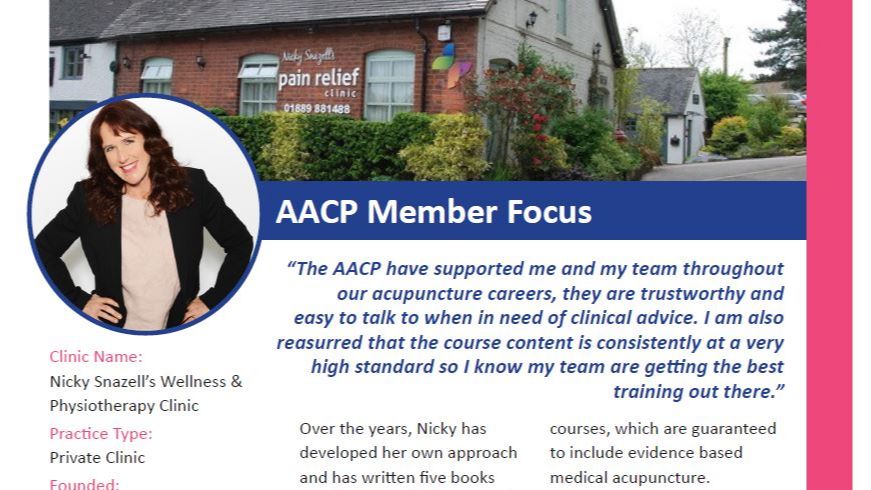
Over the years, Nicky has developed her own approach and has written five books on this. Central is the use of acupuncture and IMS and in Nicky’s opinion ‘the needle is an essential diagnostic tool’.
The clinic sends the team on AACP foundation and training days, which they find very beneficial. All four of the established physiotherapy team are AACP members and a new member is about to begin her AACP foundation course. Nicky encourages her staff to maintain AACP membership, as she “feels so much support from an organisation that has my back and that of my colleagues”. Nicky also encourages her team to gain valuable CPD via attendance of the AACP conference and courses, which are guaranteed to include evidence-based medical acupuncture.
Nicky still treats patients four or five days a week, using her own approach, which includes skills learnt with the AACP. She is also writing her sixth book specifically for therapists and is offering in-house advanced needling skills internships.
She can sometimes be found offering guest lectures at AACP events.
The Practical Application of Nicky Snazell’s Advanced Needling Skills
Nicky Snazell is one of the worlds leading GunnIMS dry needling practitioners, having reached the highest training level and awarded a fellowship of ISTOP. She has treated thousands of patients over nearly 30 years, taught IMS and presented on pain and health internationally, and written 5 books on pain and health. Nicky is a recognised authority who attracts patients from all corners of the globe.
This internship will take you from previous theory and practical courses in which you were taught WHERE to put needles, to the essential and more important step of WHY and HOW.
Internships will involve one on one with Nicky Snazell, observing while she treats complex neuro-musculoskeletal cases.
She will elaborate on:
- How you diagnose with a needle
- The difference between Eastern-based acupuncture and GunnIMS dry needling
- Physiological theories and anatomical placement of needles
- Provide an initial understanding of the WHY of treating and HOW to mix with Eastern practice.
Nicky will also provide an understanding of how her 4 Keys approach gives a baseline to both assessing the patients healing time, plus the overall health of their immune system. This will guide the most appropriate type and intensity of treatment. In other words, the dosage.
Previous experience required:
- Foundation BMAS or AACP course
- Minimum of 3 years acupuncture practice
- Chartered Physiotherapist or
- Medic with post-graduate training in MSK and acupuncture
Internship days will start at 9:30 am and finish at 3:30 pm, with a 30-minute lunch break (please bring your own lunch), and will be held at Nicky Snazell’s Clinic near Stafford.
Internship cost £250 per day
For more information, please call Nicky Snazell’s Wellness & Physiotherapy Clinic on 01889 881488.
The clinic is in central England and has rapid access to most of the country, with an excellent motorway network nearby. Stafford is only 1hr 15min by train from London.
Spinal Disk Bulge Physiotherapy For A Spinal Disc Rupture
Can a disc slip? The simple answer is no. It’s a layman’s term that is unfortunately very misleading to the general public.“My disc has slipped out, can you put it back in” is not an uncommon conversation opener on the telephone. Of course, it’s quite difficult then to get the caller to understand that this can’t actually happen, which is why Spinal Disk Bulge Physiotherapy is key to recovery.
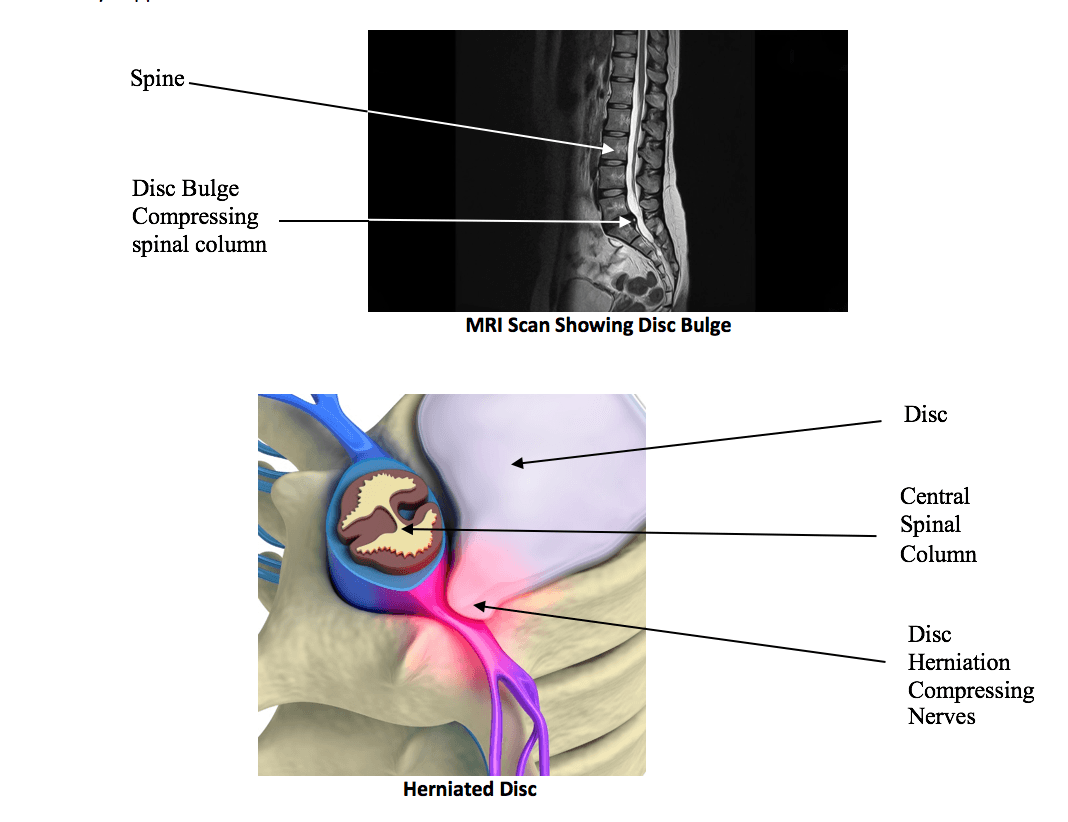
Let’s look at the spine’s anatomy and in particular the role of the disc.
The spine is made up of 7 cervical (neck) bones called vertebrae, 12 thoracics (middle) vertebrae and 5 lumbar (lower) vertebrae. The top 2 vertebrae in the neck are a little bit different, so putting those to one side, between each pair of the remaining vertebrae there is a disc, the purpose of which is to provide shock absorption and allow movement. The disc itself is attached strongly to the vertebrae and cannot slip out.
A disc is made up of a tough fibrous structure on the outside, layered in exactly the same way we make cross-ply tyres. On the inside, there is a soft, crab paste-like moist material. As we age this tends to dry out. There are also endplates in contact with the vertebrae. The spinal disc is 70% to 90% water, so making sure you are well hydrated is very important to disc health.
There are two major types of damage to these discs. The first is when the disc is overloaded sufficiently to cause a protrusion, or bulge in the outer wall, as in the diagram above. This is similar to what you see on the side of a car tyre when it has hit a curb. Sometimes this is referred to as a slipped disc. It’s not possible to just push the bulge back in, but specific exercises can help to relocate this and over time the disc may heal itself.
The second and more serious damage is when the overload has been sufficient to rupture the outer fibrous structure and force the inner material to squeeze out. This is called a herniated or ruptured disc.
What Are The Implications Of A Disc Bulge Or Herniated Disc?
A disc bulge will cause pain if it is central and compresses the central spinal column, or if it bulges to one side into the exiting nerves. In either case, if the compression is significant enough, it will cause pain and/or numbness and weakness and possibly loss of control in the limbs.
If the disc bulge is central it could cause problems down both sides of the body. If the bulge is on one side, it will only cause problems on that side.
If the disc has been ruptured or herniated, the same problems with compression of the central spinal column and exiting nerves can occur. In addition, if chemicals from the inside of the disc come into contact with the nerves, it can cause severe pain even without any compression of the nerves. In such cases, a course of anti-inflammatories will most likely be prescribed.
Can Spinal Disk Bulge Physiotherapy Treat A Disc Bulge or Herniated Disc?
In many cases, a bulging disc and a herniated disc will over time heal themselves. The time required may depend on the severity of the problem and may take from weeks to months to resolve. Physiotherapy treatment can help reduce the pain much more quickly. The key is to get an accurate diagnosis through a physiotherapy assessment, possibly needing an X-ray or MRI. Treatment can include specific exercises to help reduce the disk bulge, Gunn IMS dry needling, electroacupuncture, laser, shockwave, core stability rehab and postural rehab. In severe cases, surgery may be needed.
If you have suffered a recent back injury or had a long-term problem then it’s advisable to get your condition assessed and treated. We have extensive skills in treating spinal pain and clients travel from all over the UK and abroad to seek our help.
Call 01889 881488 now.
9 Things You Should Consider Before You Choose Your Therapist
Whatever your reason for seeking help, whether it is because you have had a recent or a long term injury, you probably want an immediate reduction. Better yet, you’re looking for a complete elimination of your pain, plus improved flexibility, to give you a much improved quality of life, while allowing you to do the things you enjoy doing, sport or otherwise.
We can help you.
But before you choose us, or anybody else, here are some things we suggest you consider first:
1. Make sure the therapist you see is a specialist in the condition you have. Most therapists will be able to help you up to a point, but if they lack specialist knowledge for treating your problem, there’s a chance that you won’t achieve the level of improvement you could, not only because of the treatment skills they can offer, but also because they may lack the ability to be able to correctly give a provisional diagnosis of the cause of your problem.
2. It’s important also that the therapist you see has sufficient experience to give you the best treatment possible. It’s no fault of the therapist but clearly there is a huge difference between someone who graduated last year and one who has 10 or more years to call on.
3. As in all things in life, not all clinics are created equal. Some are little more than a room and a static couch. If you are in a lot of pain or not very mobile, this is not great for you getting on and off the couch, and not so good for the therapist either if the couch is at the wrong height. Skilled therapists will adjust the couch height depending on the treatment they are giving you and clearly a couch that doesn’t adjust seriously compromises this.
4. Some clinics invest heavily into technology which will assist in providing you with the best treatment possible and treatment that best suits you at a particular point in your recovery. It makes sense that good technology will help the therapist to achieve the best results. Find out if the only thing on offer is a pair of hands.
5. Visiting a clinic is not just about the treatment, it’s also about the professionalism of the contact you get from the moment you make first contact, right through to the follow up after treatment. You need to know there is a friendly voice on the end of the phone who will help you make the appointments that best suit you and who are there to help when you need it.
Ease of treatment starts with ease of access, including a drop of point outside the door for those who need it, plus an ample free car park alongside. After all, who wants the hassle of having to find and pay for a distant car park and then have to walk a long way on dark, wet winter days, especially if you are in pain and not so mobile.
Arriving stress free is an important part of treatment, so make sure your clinic caters for this. A comfortable, relaxing waiting area is just as important or you could end up stressed before you even start treatment.
6. You need to be confident that the therapist you are seeing has the skills and ability you need. Find out what clinics are being talked about in the community and just as important, find out if the clinic is highly regarded in the local medical community. If your GP hasn’t heard of a clinic, there is probably a reason why.
7. Recovery for you will probably not be just a matter of a single type of treatment. As you go along your journey to recovery, you may well need a number of skills to help you. So make sure your therapist works within a clinic which is wholistic, where a broad spread of skills are available to assist in your recovery.
8. You will feel a lot more comfortable building a trusting relationship with your therapist if you can talk privately and this means it will be best for you if you have a private room for your consultation and treatment, rather than a big open plan room, with a curtain providing your only privacy.
9. Last, but not least, ask around about what the clinic or therapist is like. We have all been to places which we don’t like the feel of and don’t feel comfortable in. If you walk into a clinic that is warm, friendly and inviting, your whole frame of mind will be more positively prepared for treatment and you are much more likely to want to trust in a long term relationship. After all, we are all likely to need more than one problem fixed in our lives and we want somewhere we can go back to again and again in confidence.
'The Body’ Nicky’s second instalment of her fantastic ‘Human Garage’ Trilogy is days away from release!

‘The Body’ Nicky’s second instalment of her fantastic ‘Human Garage’ Trilogy is days away from release!
To celebrate we are offering an amazing 45% off any Magnetic Resonance Treatment. If you or someone you know needs help with Osteoarthritis, Bone Problems, Sports Injuries or Spinal Disc issues.
Call us on 01889 881488
“For a longer active life”
Offer ends 30th September
Terms and Conditions apply.
The key to healthly exercise
The key to healthly exercise is just that.Let’s take another look at why we should exercise so we can hold a green fitness key.Today I find that humans are far too sedentary, all too
often sitting in front of a computer by day, followed by
sitting in front of a TV at night. This lack of physical
activity causes emotional and physiological imbalances,
but we can change this by looking at how we exercise; improving your
fitness changes your chemistry, acts as a powerful antidepressant, promotes
mental clarity, and reduces the likelihood of cancer.
If you’re not happy with either how you look or feel about your weight,
then with correct guidance, you can break out of inactivity and be rewarded
by smiling at yourself whenever you see your reflection. I will guide you towards 4 green keys to health and tonight is fitness.
You can learn more about how and when you should
exercise, as getting the correct mix can extend your life.
When I am working at my clinic, I hear echoing around the walls: I am too
old to exercise, too old to work. Are you too old to exercise? Well, no one told
Jiroemon Kimura (born 1897) that he was too old. He passed away recently
at age 116, farming until he was 90 years old. Remember the Carry On films?
Well, did you know that Barbara Windsor carries on exercising in her late 70s?
You can find her in her gym wear keeping fit outside in Hyde Park.
Over 450,000 people in the USA and over 70,000 people in the UK risk total
knee replacement every year. Want to talk pain? Then talk TKR. What’s
worse is that it is unsuccessful 10% of the time, and you can even die from
having total knee replacement. Furthermore, the age for TKR is constantly
dropping. Why? Anybody want to hazard a guess? That’s right: obesity.
Now, this isn’t proven yet, but it is most likely the biggest cause.
So, what happens when you get fat? Ladies, take the ‘C’ off chips and you
know what you get! Guys, you put it on around the waist and lose sight of
your favourite toy! What you probably don’t know is that your knees are
loaded with up to four times your weight, so every extra stone (14 lbs) is
an extra four stone (56 lbs) on your knees – that’s why knees are so often
the first casualty with OA. If you want to know why the four times multiple
occurs, it’s because of leverage. Now, you are intelligent people, and you are
surely interested in health or you wouldn’t be here. So, why have you made
the decision to get arthritis? Made the decision to get lots of pain? Made
the decision to risk surgery and even death? It’s because much of the pain
associated with the pleasure of eating too much is too far away, and anyway,
going to the gym is a pain for most. We need to change the way we think
about exercise, and hopefully this chapter will go some way to doing that
for you.
Here’s some more cheery news: an in-depth study into retirement found
that men in their sixties are every bit as good at driving business than those
physically and mentally in their prime. In later life, prescriptive exercise is
more effort than swallowing a pill, but it is well worth it; in a nutshell, you get
less senility and less pain. Exercise weaves its magic, strengthening the heart,
releasing more neurotransmitters for cell communication, boosting BDNF
for improving neural connections in the brain, aiding metabolism, improving
blood flow, stimulating toxic disposal systems, and strengthening bones.
This next fact gets me out running in howling gales and rain: current research
in Sweden shows that exercise alters the way genes work in the tissue that
stores fat, and changes in adipose tissue storage sites were measurable even
with just two workouts a week. Epigenetics has always fascinated me since
studying biology, and this is the study of how chemical alterations will
change how genes work in a cell. This allows us to fine tune our body to a
changing environment.
Exercise alters this process in muscle cells and improves how sugar is
processed. Furthermore, adipose tissue (fat cells) is an organ in its own right, producing active chemicals that have profound effects on the body. In
this tissue, 18,000 markers were found on 7,663 genes! This is leading to a
greater understanding of why exercise helps fatty tissue do its job properly,
which means that as we get older, we don’t have to have such a lumpy,
bumpy body. This smooth body needs a good structural support.