
Spinal Disk Bulge Physiotherapy For A Spinal Disc Rupture
Can a disc slip? The simple answer is no. It’s a layman’s term that is unfortunately very misleading to the general public.“My disc has slipped out, can you put it back in” is not an uncommon conversation opener on the telephone. Of course, it’s quite difficult then to get the caller to understand that this can’t actually happen, which is why Spinal Disk Bulge Physiotherapy is key to recovery.
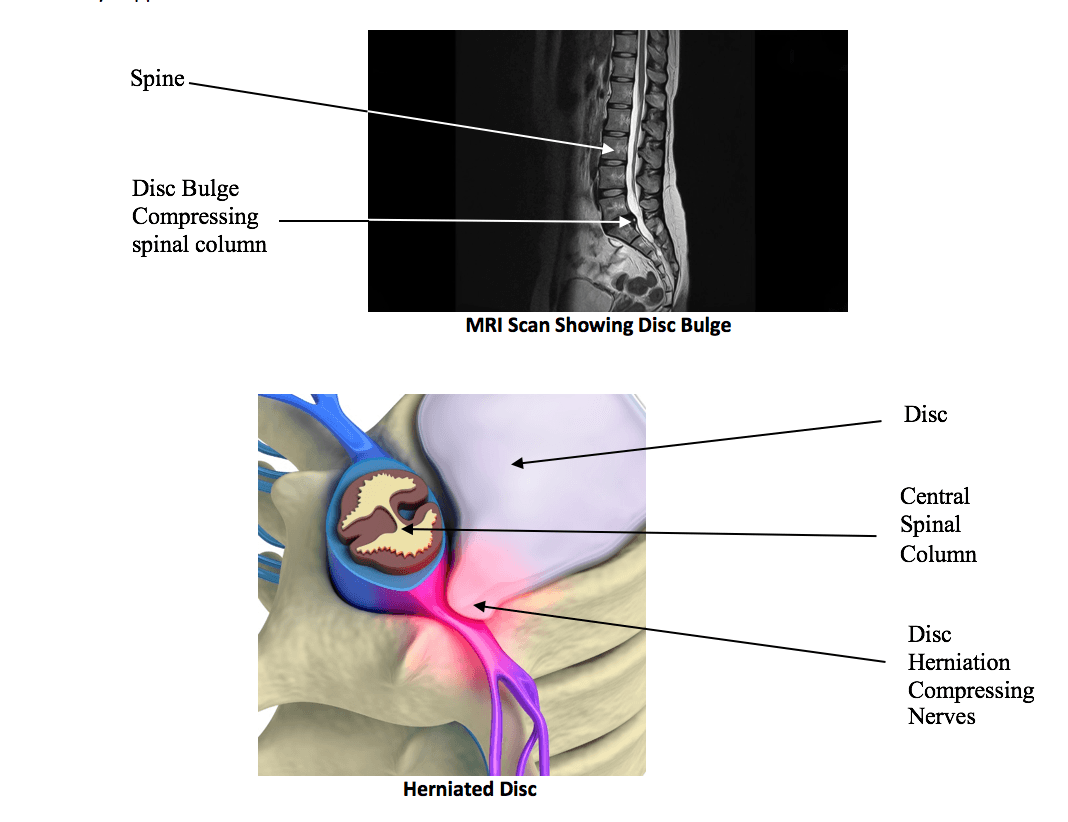
Let’s look at the spine’s anatomy and in particular the role of the disc.
The spine is made up of 7 cervical (neck) bones called vertebrae, 12 thoracics (middle) vertebrae and 5 lumbar (lower) vertebrae. The top 2 vertebrae in the neck are a little bit different, so putting those to one side, between each pair of the remaining vertebrae there is a disc, the purpose of which is to provide shock absorption and allow movement. The disc itself is attached strongly to the vertebrae and cannot slip out.
A disc is made up of a tough fibrous structure on the outside, layered in exactly the same way we make cross-ply tyres. On the inside, there is a soft, crab paste-like moist material. As we age this tends to dry out. There are also endplates in contact with the vertebrae. The spinal disc is 70% to 90% water, so making sure you are well hydrated is very important to disc health.
There are two major types of damage to these discs. The first is when the disc is overloaded sufficiently to cause a protrusion, or bulge in the outer wall, as in the diagram above. This is similar to what you see on the side of a car tyre when it has hit a curb. Sometimes this is referred to as a slipped disc. It’s not possible to just push the bulge back in, but specific exercises can help to relocate this and over time the disc may heal itself.
The second and more serious damage is when the overload has been sufficient to rupture the outer fibrous structure and force the inner material to squeeze out. This is called a herniated or ruptured disc.
What Are The Implications Of A Disc Bulge Or Herniated Disc?
A disc bulge will cause pain if it is central and compresses the central spinal column, or if it bulges to one side into the exiting nerves. In either case, if the compression is significant enough, it will cause pain and/or numbness and weakness and possibly loss of control in the limbs.
If the disc bulge is central it could cause problems down both sides of the body. If the bulge is on one side, it will only cause problems on that side.
If the disc has been ruptured or herniated, the same problems with compression of the central spinal column and exiting nerves can occur. In addition, if chemicals from the inside of the disc come into contact with the nerves, it can cause severe pain even without any compression of the nerves. In such cases, a course of anti-inflammatories will most likely be prescribed.
Can Spinal Disk Bulge Physiotherapy Treat A Disc Bulge or Herniated Disc?
In many cases, a bulging disc and a herniated disc will over time heal themselves. The time required may depend on the severity of the problem and may take from weeks to months to resolve. Physiotherapy treatment can help reduce the pain much more quickly. The key is to get an accurate diagnosis through a physiotherapy assessment, possibly needing an X-ray or MRI. Treatment can include specific exercises to help reduce the disk bulge, Gunn IMS dry needling, electroacupuncture, laser, shockwave, core stability rehab and postural rehab. In severe cases, surgery may be needed.
If you have suffered a recent back injury or had a long-term problem then it’s advisable to get your condition assessed and treated. We have extensive skills in treating spinal pain and clients travel from all over the UK and abroad to seek our help.
Call 01889 881488 now.
'The Body’ Nicky’s second instalment of her fantastic ‘Human Garage’ Trilogy is days away from release!

‘The Body’ Nicky’s second instalment of her fantastic ‘Human Garage’ Trilogy is days away from release!
To celebrate we are offering an amazing 45% off any Magnetic Resonance Treatment. If you or someone you know needs help with Osteoarthritis, Bone Problems, Sports Injuries or Spinal Disc issues.
Call us on 01889 881488
“For a longer active life”
Offer ends 30th September
Terms and Conditions apply.
For the love of dance
 Love to Dance…
For those of you who love to dance on a regular basis – whether for your job, for exercise or for the sheer love of it – you will already by familiar with the absolute joy that dancing can bring you, and you’ll crave that unmistakable “buzz” inside you, with the happy endorphins kicking in whilst you move your body to the beat. The genre of music and style of dance doesn’t matter – you’ll simply know the passion it brings out in you, and in others who share your love of it.
However, dancers will also be only too familiar with how tough dancing can be on the body, and often, after hours of blissful dancing, you will then find yourselves aching – in your back, you neck, shoulders, hips… and especially in your knees and feet, which can take quite a hammering with all that bending, sliding, spinning and turning!
Usually, within a day or two, the soreness wears off, and you’re craving your next dance.
But sometimes the problem can be more worrying, with severe pain developing, causing you to restrict your dancing – or even prevent you from dancing altogether for a while.
A few examples include:
• Menisus Knee Tear, from twisting the knee whilst moving;
• Lower Back strain and muscle spasms;
• Plantar Fasciitis – pain as you put weight on your foot;
• Hallux Limitus, where your big toe becomes stiff;
• Patellofemoral Pain Syndrome, from tight hamstrings and calf muscles, and weak quads, plus repetitive pressure on the knee cap;
• Ankle sprains – eg, from landing wrongly from a jump;
• Tendonopathy of the Rotator Cuff, Posterior Tibial tendon, and in the Achilles.
Fear not… Help is at hand!
Yes, we can help you if you are suffering with any of these. At the Nicky Snazell Pain Relief Clinic, we have treatments whereby we can actively intervene to get you back to doing what you love. And the sooner you do something about it, the less damage you will cause – and the sooner you can return to the dance-floor.
Happy dancing!
The key to healthly exercise
The key to healthly exercise is just that.Let’s take another look at why we should exercise so we can hold a green fitness key.Today I find that humans are far too sedentary, all too
often sitting in front of a computer by day, followed by
sitting in front of a TV at night. This lack of physical
activity causes emotional and physiological imbalances,
but we can change this by looking at how we exercise; improving your
fitness changes your chemistry, acts as a powerful antidepressant, promotes
mental clarity, and reduces the likelihood of cancer.
If you’re not happy with either how you look or feel about your weight,
then with correct guidance, you can break out of inactivity and be rewarded
by smiling at yourself whenever you see your reflection. I will guide you towards 4 green keys to health and tonight is fitness.
You can learn more about how and when you should
exercise, as getting the correct mix can extend your life.
When I am working at my clinic, I hear echoing around the walls: I am too
old to exercise, too old to work. Are you too old to exercise? Well, no one told
Jiroemon Kimura (born 1897) that he was too old. He passed away recently
at age 116, farming until he was 90 years old. Remember the Carry On films?
Well, did you know that Barbara Windsor carries on exercising in her late 70s?
You can find her in her gym wear keeping fit outside in Hyde Park.
Over 450,000 people in the USA and over 70,000 people in the UK risk total
knee replacement every year. Want to talk pain? Then talk TKR. What’s
worse is that it is unsuccessful 10% of the time, and you can even die from
having total knee replacement. Furthermore, the age for TKR is constantly
dropping. Why? Anybody want to hazard a guess? That’s right: obesity.
Now, this isn’t proven yet, but it is most likely the biggest cause.
So, what happens when you get fat? Ladies, take the ‘C’ off chips and you
know what you get! Guys, you put it on around the waist and lose sight of
your favourite toy! What you probably don’t know is that your knees are
loaded with up to four times your weight, so every extra stone (14 lbs) is
an extra four stone (56 lbs) on your knees – that’s why knees are so often
the first casualty with OA. If you want to know why the four times multiple
occurs, it’s because of leverage. Now, you are intelligent people, and you are
surely interested in health or you wouldn’t be here. So, why have you made
the decision to get arthritis? Made the decision to get lots of pain? Made
the decision to risk surgery and even death? It’s because much of the pain
associated with the pleasure of eating too much is too far away, and anyway,
going to the gym is a pain for most. We need to change the way we think
about exercise, and hopefully this chapter will go some way to doing that
for you.
Here’s some more cheery news: an in-depth study into retirement found
that men in their sixties are every bit as good at driving business than those
physically and mentally in their prime. In later life, prescriptive exercise is
more effort than swallowing a pill, but it is well worth it; in a nutshell, you get
less senility and less pain. Exercise weaves its magic, strengthening the heart,
releasing more neurotransmitters for cell communication, boosting BDNF
for improving neural connections in the brain, aiding metabolism, improving
blood flow, stimulating toxic disposal systems, and strengthening bones.
This next fact gets me out running in howling gales and rain: current research
in Sweden shows that exercise alters the way genes work in the tissue that
stores fat, and changes in adipose tissue storage sites were measurable even
with just two workouts a week. Epigenetics has always fascinated me since
studying biology, and this is the study of how chemical alterations will
change how genes work in a cell. This allows us to fine tune our body to a
changing environment.
Exercise alters this process in muscle cells and improves how sugar is
processed. Furthermore, adipose tissue (fat cells) is an organ in its own right, producing active chemicals that have profound effects on the body. In
this tissue, 18,000 markers were found on 7,663 genes! This is leading to a
greater understanding of why exercise helps fatty tissue do its job properly,
which means that as we get older, we don’t have to have such a lumpy,
bumpy body. This smooth body needs a good structural support.